Have you ever wondered how some businesses seem to have a presence no matter where you are in the world?
Well, that’s the power of international advertising!
Nowadays, businesses aren’t just serving the local markets: they’re spreading their messages across the globe, tailoring their approach to different cultures and languages.
But how do they manage to do it? And why is it vital?
This article breaks down what international advertising is all about. Read on for key benefits and practices for a successful global marketing strategy!
What is international advertising?
International advertising is the process of promoting a product or service in multiple countries or regions. It goes beyond simply translating existing marketing materials into other languages.
Effective advertising campaigns require adapting your messaging to fit different cultural norms, local preferences, and economic conditions.
When expanding to global markets, strategic international media buying and planning is crucial for reaching the right audience. Different regions may favour various platforms, such as TV, social media, or print.
To succeed, it’s essential to choose the best channels for each international market and adapt your content to local preferences.
What are the benefits of international advertising?
If you’re wondering why you should consider global advertising, here are a few reasons:
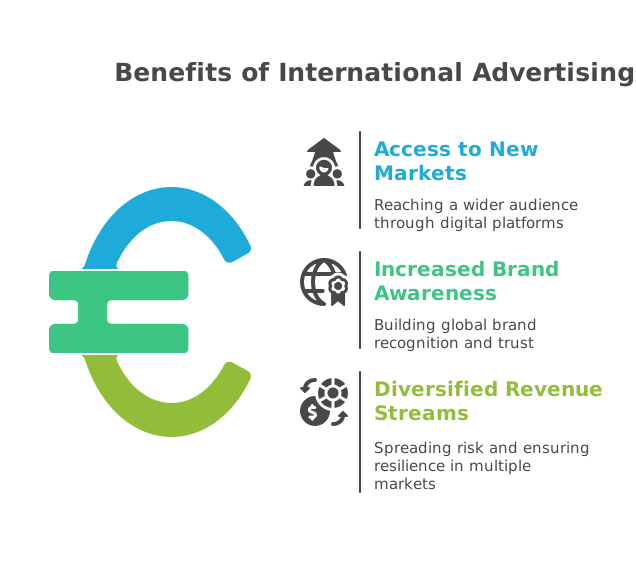
Access to new markets
One of the biggest benefits of international advertising is reaching a wider audience. Instead of limiting yourself to one market, you can introduce your products to millions of new customers worldwide.
The best part? Digital platforms like Google, Facebook, and Instagram make it easier to connect with international audiences.
These platforms allow you to target specific regions, ensuring that your ads reach the right people.
Increased brand awareness
Expanding into international markets helps build global brand recognition.
When people in different countries see your advertisements, it creates awareness and trust.
Your brand becomes familiar to a broad audience, strengthening its presence in new markets. This opens doors to new opportunities and partnerships that may not be available in just one market.
Diversified revenue streams
The global market offers the chance to diversify revenue streams. Relying on just one market can be risky, especially if that market experiences economic difficulties or increased competition.
Reaching customers in multiple countries spreads the risk and reduces dependence on any single market. This creates a safety net, making the company more resilient against economic changes and ensuring continued growth.
Embracing international advertising expands your reach, strengthens your brand, and opens doors to new opportunities. It helps you build a more resilient and innovative business in a global market.
Best Practices for International Advertising
For a successful international advertising, here are a few tips to consider:
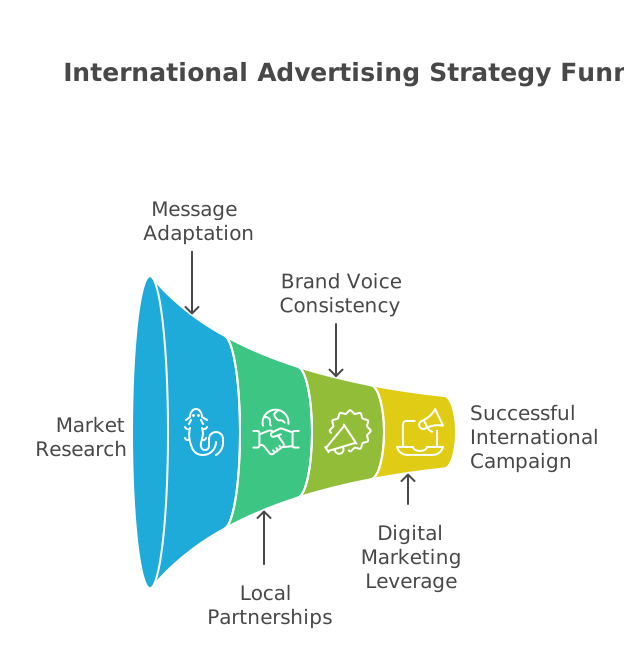
Research your target markets
Before starting an international advertising campaign, it’s crucial to research the regions you’re targeting.
Understanding the cultural, economic and social factors that shape buying behaviour in these areas will help you create more effective campaigns. This ensures that your message will resonate with local consumers.
Adapt your message
Translating your ads into another language isn’t enough to reach international audiences effectively.
What appeals to your home market may not connect with consumers in other regions. Instead, adapt and localise your message to fit the cultural context of each target market.
This could mean changing visuals, adjusting taglines, or even reworking the entire ad concept to align with local customs and values.
Work with local partners
Partnering with local agencies or experts is a smart move for international marketing. They understand the cultural nuances, legal requirements, and consumer preferences in their regions, helping you navigate these complexities.
Their insights can prevent costly mistakes and ensure your campaign connects with the target audience.
Use a consistent brand voice
Maintaining a consistent brand voice is crucial, even when tailoring your message for different markets. Consistency helps build trust and makes it easy for your global audience to recognise your brand.
You can adjust the tone and language to match local preferences, but the core values and personality of your brand should stay the same.
This balance ensures your brand connects with new audiences while staying true to its identity.
Leverage digital marketing
Digital platforms such as social media and search engines simplify reaching international audiences.
These tools offer targeted advertising options, allowing you to create ads that fit specific regions, languages, and demographics.
With digital marketing tools, you can track campaign performance in real time and make data-driven adjustments.
This helps you optimise your ads and ensures they effectively reach your target audience.
Implementing these best practices can help you create a successful international marketing campaign that resonates with diverse audiences.
This way, you can expand your reach and build a solid global presence while staying true to your brand identity.
Conclusion
International advertising isn’t just a marketing strategy for big corporations; it’s becoming increasingly accessible and crucial for businesses of all sizes in the global market.
Expanding your reach beyond borders will allow you to open a world of opportunities for growth, learning, and innovation.
Remember, success in international advertising doesn’t happen overnight. It requires thorough market research, cultural sensitivity, and a willingness to adapt.
Monolingual Britain and the Case for Professional Translation Services 🇬🇧
British businesses carry a quiet handicap into every international deal: most of the people running them speak only one language. English opens doors across the world, so it feels efficient to lean on it — until an HMRC letter arrives in French, a Spanish distributor proposes contract amendments, or a German buyer asks for product documentation in their own language. That is the moment English stops being enough.
Britain’s monolingual habit — and what it costs UK businesses
The UK is, statistically, one of the least multilingual countries in Europe. British Council research puts the proportion of adults who speak only English at roughly two-thirds of the population, and the same research found that a sizeable minority wish they had made the effort to learn a second one.
A British Council survey of 3,000 UK adults found that roughly one in four regret never having learnt another language fluently, and nearly a quarter believe adding a second language matters more than ever for life and work in Britain.
Source: British Council press release, 2023
That gap is not just a cultural footnote. A study commissioned by the former UK Trade & Investment department (Foreman-Peck and Wang, 2014) concluded that weak language capability holds the UK back from trade it would otherwise win. The All-Party Parliamentary Group (APPG) for Modern Languages has repeated the finding consistently in its reporting to Parliament.
Research cited by the APPG for Modern Languages estimates the UK loses around 3.5% of GDP every year in lost trade, largely because of weak second-language capability across business and government.
Source: APPG for Modern Languages / Foreman-Peck & Wang (UKTI, 2014), via New Statesman Spotlight
For an exporter in Manchester, a law firm in the City of London, or an e-commerce brand shipping from Birmingham, that is not an abstract figure. It is the quote you did not win, the distributor who chose a German competitor, and the Companies House filing your overseas partner could not read.
Why school French rarely translates into business fluency
Most British pupils encounter a second language — usually French, Spanish, or German — at secondary school. The trouble is that language study is only compulsory to age 14, and A-level entries in modern foreign languages have been falling for more than a decade. GCSE classes give pupils a foothold, not fluency.
Even disciplined adult learners rarely reach the level needed to draft a commercial contract, negotiate a cross-border supply agreement, or prepare a Home Office immigration bundle. Language apps, evening classes, and private tutors will help you travel and socialise. They will not prepare you to be legally and commercially accountable in a second language.
When Google Translate and bilingual colleagues fall short
For internal email or a quick message to a holiday rental, machine translation is fine. For anything that carries legal, financial, or reputational weight, it is not.
Consider where UK businesses routinely need professional language support: contracts bound by English law but signed with EU, Middle Eastern, or Asian counterparties; HMRC correspondence and tax filings for overseas operations; Home Office documents for Skilled Worker visas and Right to Work checks; patient information leaflets and consent forms for the NHS; Companies House filings and due-diligence packs for M&A; product manuals that must comply with UK and EU safety regulations.
In each of these, an error in translation is not an inconvenience — it is a liability. Which is why any serious UK business eventually arrives at the same question: who handles this properly?
What professional translation services actually cover
A capable language partner does far more than swap text word-for-word. BeTranslated’s professional translation services for UK businesses are built around the situations that actually come up in British commercial life.
Legal translation UK. Commercial contracts, shareholder agreements, court filings, witness statements, and regulatory correspondence for UK courts and tribunals — handled by translators with a legal background rather than generalists.
Certified and sworn translation UK. Official translations for the Home Office, UK visa applications, marriage and birth certificates, academic qualifications, and apostille/legalisation for use abroad. The UK does not operate a sworn-translator register in the way Spain or France does, so certification here is provided through a qualified translator’s formal statement of truth.
Website localisation UK. Adapting your site for British buyers — British spelling, pricing in pounds, UK legal notices, and culturally appropriate references — or for the overseas markets you want to enter. Localisation is not translation with a thesaurus; it is rebuilding the site so a reader in Paris, Madrid, or Amsterdam feels it was written for them.
UK SEO translation services. On-page and off-page SEO for multilingual websites: keyword research in each target language, meta tags, structured data, hreflang, and localised content that ranks in Google’s regional indexes.
Technical and medical translation. Product manuals, NHS patient-facing documentation, clinical trial paperwork, and engineering specifications, delivered by subject-matter specialists.
Interpreting. Remote and on-site interpreters for UK business meetings, arbitration, medical appointments, and conferences — covering the languages actually in demand across British cities, including London, Manchester, and Edinburgh.
The commercial upside is not theoretical.
The APPG’s National Recovery Programme for Languages reports that UK SMEs deploying language skills achieve export-to-turnover ratios around 43% higher than their monolingual competitors.
Source: APPG for Modern Languages, 2019, via British Council Voices
Learn languages where you can — hire professionals when it matters
None of this argues against personal language learning. A director who can open a meeting in French or close it in German builds trust in ways no translation ever will, and the appetite is there: the British Council’s data shows 18–24-year-olds are the keenest group, with more than a third saying they have always wanted to learn another language.
But running a UK business in 2026 means dealing with contracts, regulators, and customers in more languages than any one person can master. You do not translate your own audit. You do not write your own tax opinion. You should not translate your own commercial documents either. When the stakes are high, bring in specialists. Request a free quote from our UK team and keep practising the languages you already have.
FAQs: Professional translation services in the UK
Do I need a sworn translator in the UK?
Unlike Spain, France, or Germany, the UK does not operate a sworn-translator register. For most official purposes — UK visas, Home Office applications, academic recognition — you need a certified translation, produced by a qualified translator and accompanied by a signed statement of truth confirming accuracy. For documents going abroad, you may also need notarisation or apostille through the Foreign, Commonwealth and Development Office.
How much do professional translation services cost in the UK?
UK pricing is typically quoted per word, per page, or per project. Rates depend on language pair, subject-matter complexity (a financial contract costs more than marketing copy), certification requirements, and turnaround. Expect a premium for urgent, legal, or medical work. BeTranslated provides a free, fixed quote before any work begins, with no hidden fees.
Which documents usually require certified translation for UK visas and Home Office applications?
Typically: birth, marriage, and death certificates; academic transcripts and diplomas; police certificates; divorce decrees; bank statements; and sponsorship letters for Skilled Worker or family visa applications. The Home Office requires certified translations for any supporting document that is not in English or Welsh.
What is the difference between translation and website localisation for a UK audience?
Translation converts the meaning of your text. Localisation adapts the whole experience — spelling (colour vs color), currency, dates, units, imagery, cultural references, legal notices, and SEO. A US site localised for the UK might change “shipping” to “delivery”, “$” to “£”, and “zip code” to “postcode”, among dozens of other adjustments. Done well, localisation also covers multilingual SEO so you rank on google.co.uk and other local Google domains.
How long does a UK legal or business translation take?
A short contract or certificate is usually ready within 24–48 hours. A full set of M&A due-diligence documents, a multilingual website, or a technical manual will take longer and is scoped on a project basis. BeTranslated confirms the deadline in writing when the quote is accepted, and delivers through a single UK project manager so you always have one point of contact.