by Michael Bastin | 11 Mar, 2021 | Business Tips, Multilingual, Translation services
With the rapid growth of social media, online platforms and e-commerce sites, it has never been as vital as it is now to ensure your message and content is shared widely.
For example, the number of videos posted on a network like Facebook has exploded to the point that an estimated 100 million hours of video are consumed by internet users each day.
Companies that turn to these communication channels have seen their turnover skyrocket and their international customers grow in unexpected numbers. That’s where video subtitling comes in.
What can video subtitling offer your organisation?
Everyone agrees, your company video presentation was a roaring success, yet there have been no clicks.
Why could that be? Well, it’s worth bearing in mind that over 8 out of 10 videos online are watched with the sound off.
And this applies across social networks and broadcasting mediums.
Ads, trailers, excerpts of speeches and TV programmes are usually watched with the sound off, pushing more and more organisations to have their audiovisual content subtitled by an audiovisual translation agency.
The pros of English subtitles
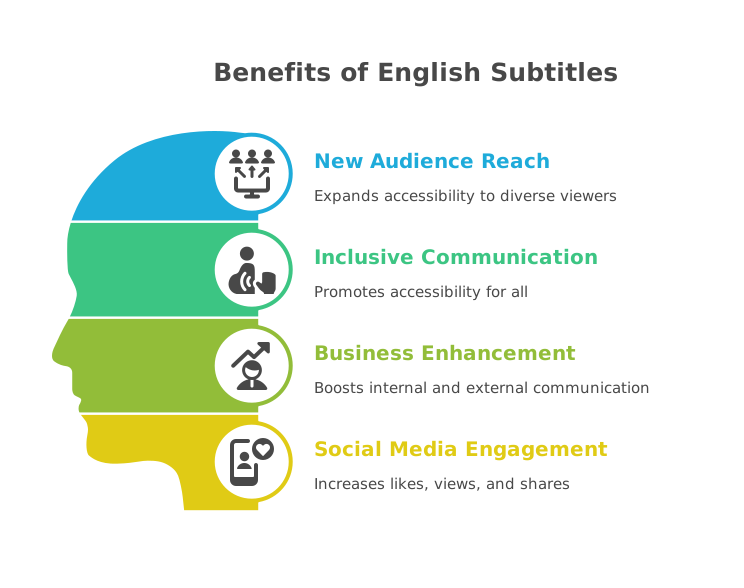
With subtitles in English, you will be able to reach out to a new audience that, so far, has not been able to access your audiovisual content.
For example, once subtitled in English your video will be accessible to people who are deaf or hard of hearing, that’s 11 million people in the UK alone.
This method, known as closed captioning, is part of the inclusive communication philosophy that arrived with the early 21st century and allows a larger number of people to access information.
English subtitles on your video will broaden your field of activity and boost your message’s circulation both within your business, through meetings and presentations, and externally to social media users or as part of a client-canvassing strategy.
A recent study by Facebook showed that a subtitled video or short film received 10% more likes while its viewing time increased by 12% and shares by a massive 26%! Tempting, isn’t it?
Subtitling in other European languages – a door to more marketplaces
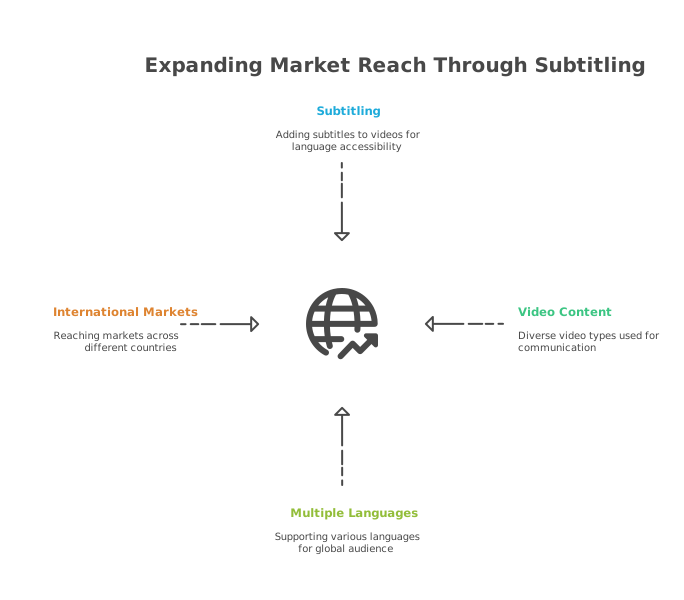
To go even further, and really connect with a huge international audience, many organisations make a habit of subtitling their video content such as their ads, marketing videos, company presentations, official communications and training videos.
Sharing communications of this type in multiple languages on their website or e-commerce platform is one of the best development strategies that internationally-minded companies can put in place.
Free of language restrictions, your company video can travel wide, from Brazil to France, passing through Japan and Spain en route.
Video subtitling – bring in the professionals
However, to be able to do this, your video will have to be subtitled by a professional translation agency.
It is vital to put your trust in specialist audiovisual translators who know the rights and wrongs of subtitling like the back of their hand, whether that’s for films, short videos or even documentaries and educational films. Otherwise, the proof will be in the video.
These linguists are not only natives of the relevant countries, and so understand the linguistic uses and customs perfectly, but they alone will know how to reconvey your message in line with the many rules of professional subtitling, such as character limits, spotting and managing different types of files and colour codes in closed captions.
Trust us with your video content, and we would be delighted to get back to you with a prompt quote taking into account the film’s duration and your personal requirements.
As the digital age continues to evolve and explode with new and useful tools, the allure of using AI for content creation and translation is undeniable.
Yet, it’s vital to remember the unique value of human touch.
At BeTranslated, we specialise in humanization, offering nuanced understanding, cultural sensitivity, and emotional intelligence that AI cannot replicate.
Our team ensures your message is not only accurate but culturally resonant, with a commitment to confidentiality and human responsibility at the core of our services.
While AI can streamline processes, the expertise and personal care of our professionals guarantee your content accurately reflects your brand’s essence.
Choose BeTranslated for a blend of technology and human expertise, where your message’s integrity and confidentiality are our top priority.
by Michael Bastin | 14 Feb, 2020 | Languages, Business Tips, Multilingual
Employing multilingual people or staff with a knowledge of foreign languages is crucial for companies that are working at an international level.
Having a good knowledge of English, for example, is a significant advantage in the workplace as in many locations around the globe English is considered a lingua franca when working with overseas clients.
With that said, the ability to master additional languages could be just the thing that gives your business the competitive edge.
This is particularly important when doing business in regions where knowledge of English is not a given.
Consider hiring staff that are proficient in languages that are relevant to your sector, whether that’s Spanish, French, Chinese, Korean or any other language.
The benefits of speaking your clients’ native language
Your client will view your dedication to having invested the time to learn their language as a long-term commitment.
Furthermore, this will reward you with long-standing relationships and loyalty from your customers. It’s also worth noting that having an understanding of the language used in your new market will enable you to acquire far better insights into the local character, customs, and beliefs.
This is invaluable knowledge when it comes to marketing and providing the best service to your clients.
Multilingual employees help foster strong relationships with clients
Employing multilingual people can bring great benefits to your company. These employees will enable your business to seamlessly connect with foreign customers and other local organisations.
The ability to provide your services in multiple languages gives clients a strong impression of your company; it will build greater trust and appreciation for your services, resulting in strong relationships with your clients.
These relationships can be translated into significant profits, meaning hiring multilingual employees is a sensible financial decision.
What if your team isn’t multilingual?
Not all companies have the luxury of employing multilingual people, which can put them at a disadvantage. But never fear!
By hiring a professional translation service, your company can gain many of the benefits of multilingual employees, and more besides.
Translators can be used for a wide variety of communicative tasks, from informal communications between companies to legal contracts and marketing campaigns.
Contracting professional translators guarantees that any content you produce in the target language is of the highest quality.
BeTranslated’s vast network of expert translators could be just the thing your company needs to facilitate its international expansion.
Get in touch today for more information or a free, no-obligation quote.
by Michael Bastin | 13 Feb, 2020 | Education, Adventures in Globalization & Localization, Multilingual
Monolingual Britain and the Case for Professional Translation Services 🇬🇧
British businesses carry a quiet handicap into every international deal: most of the people running them speak only one language. English opens doors across the world, so it feels efficient to lean on it — until an HMRC letter arrives in French, a Spanish distributor proposes contract amendments, or a German buyer asks for product documentation in their own language. That is the moment English stops being enough.
Britain’s monolingual habit — and what it costs UK businesses
The UK is, statistically, one of the least multilingual countries in Europe. British Council research puts the proportion of adults who speak only English at roughly two-thirds of the population, and the same research found that a sizeable minority wish they had made the effort to learn a second one.
A British Council survey of 3,000 UK adults found that roughly one in four regret never having learnt another language fluently, and nearly a quarter believe adding a second language matters more than ever for life and work in Britain.
Source: British Council press release, 2023
That gap is not just a cultural footnote. A study commissioned by the former UK Trade & Investment department (Foreman-Peck and Wang, 2014) concluded that weak language capability holds the UK back from trade it would otherwise win. The All-Party Parliamentary Group (APPG) for Modern Languages has repeated the finding consistently in its reporting to Parliament.
Research cited by the APPG for Modern Languages estimates the UK loses around 3.5% of GDP every year in lost trade, largely because of weak second-language capability across business and government.
Source: APPG for Modern Languages / Foreman-Peck & Wang (UKTI, 2014), via New Statesman Spotlight
For an exporter in Manchester, a law firm in the City of London, or an e-commerce brand shipping from Birmingham, that is not an abstract figure. It is the quote you did not win, the distributor who chose a German competitor, and the Companies House filing your overseas partner could not read.
Why school French rarely translates into business fluency
Most British pupils encounter a second language — usually French, Spanish, or German — at secondary school. The trouble is that language study is only compulsory to age 14, and A-level entries in modern foreign languages have been falling for more than a decade. GCSE classes give pupils a foothold, not fluency.
Even disciplined adult learners rarely reach the level needed to draft a commercial contract, negotiate a cross-border supply agreement, or prepare a Home Office immigration bundle. Language apps, evening classes, and private tutors will help you travel and socialise. They will not prepare you to be legally and commercially accountable in a second language.
When Google Translate and bilingual colleagues fall short
For internal email or a quick message to a holiday rental, machine translation is fine. For anything that carries legal, financial, or reputational weight, it is not.
Consider where UK businesses routinely need professional language support: contracts bound by English law but signed with EU, Middle Eastern, or Asian counterparties; HMRC correspondence and tax filings for overseas operations; Home Office documents for Skilled Worker visas and Right to Work checks; patient information leaflets and consent forms for the NHS; Companies House filings and due-diligence packs for M&A; product manuals that must comply with UK and EU safety regulations.
In each of these, an error in translation is not an inconvenience — it is a liability. Which is why any serious UK business eventually arrives at the same question: who handles this properly?
What professional translation services actually cover
A capable language partner does far more than swap text word-for-word. BeTranslated’s professional translation services for UK businesses are built around the situations that actually come up in British commercial life.
Legal translation UK. Commercial contracts, shareholder agreements, court filings, witness statements, and regulatory correspondence for UK courts and tribunals — handled by translators with a legal background rather than generalists.
Certified and sworn translation UK. Official translations for the Home Office, UK visa applications, marriage and birth certificates, academic qualifications, and apostille/legalisation for use abroad. The UK does not operate a sworn-translator register in the way Spain or France does, so certification here is provided through a qualified translator’s formal statement of truth.
Website localisation UK. Adapting your site for British buyers — British spelling, pricing in pounds, UK legal notices, and culturally appropriate references — or for the overseas markets you want to enter. Localisation is not translation with a thesaurus; it is rebuilding the site so a reader in Paris, Madrid, or Amsterdam feels it was written for them.
UK SEO translation services. On-page and off-page SEO for multilingual websites: keyword research in each target language, meta tags, structured data, hreflang, and localised content that ranks in Google’s regional indexes.
Technical and medical translation. Product manuals, NHS patient-facing documentation, clinical trial paperwork, and engineering specifications, delivered by subject-matter specialists.
Interpreting. Remote and on-site interpreters for UK business meetings, arbitration, medical appointments, and conferences — covering the languages actually in demand across British cities, including London, Manchester, and Edinburgh.
The commercial upside is not theoretical.
The APPG’s National Recovery Programme for Languages reports that UK SMEs deploying language skills achieve export-to-turnover ratios around 43% higher than their monolingual competitors.
Source: APPG for Modern Languages, 2019, via British Council Voices
Learn languages where you can — hire professionals when it matters
None of this argues against personal language learning. A director who can open a meeting in French or close it in German builds trust in ways no translation ever will, and the appetite is there: the British Council’s data shows 18–24-year-olds are the keenest group, with more than a third saying they have always wanted to learn another language.
But running a UK business in 2026 means dealing with contracts, regulators, and customers in more languages than any one person can master. You do not translate your own audit. You do not write your own tax opinion. You should not translate your own commercial documents either. When the stakes are high, bring in specialists. Request a free quote from our UK team and keep practising the languages you already have.
FAQs: Professional translation services in the UK
Do I need a sworn translator in the UK?
Unlike Spain, France, or Germany, the UK does not operate a sworn-translator register. For most official purposes — UK visas, Home Office applications, academic recognition — you need a certified translation, produced by a qualified translator and accompanied by a signed statement of truth confirming accuracy. For documents going abroad, you may also need notarisation or apostille through the Foreign, Commonwealth and Development Office.
How much do professional translation services cost in the UK?
UK pricing is typically quoted per word, per page, or per project. Rates depend on language pair, subject-matter complexity (a financial contract costs more than marketing copy), certification requirements, and turnaround. Expect a premium for urgent, legal, or medical work. BeTranslated provides a free, fixed quote before any work begins, with no hidden fees.
Which documents usually require certified translation for UK visas and Home Office applications?
Typically: birth, marriage, and death certificates; academic transcripts and diplomas; police certificates; divorce decrees; bank statements; and sponsorship letters for Skilled Worker or family visa applications. The Home Office requires certified translations for any supporting document that is not in English or Welsh.
What is the difference between translation and website localisation for a UK audience?
Translation converts the meaning of your text. Localisation adapts the whole experience — spelling (colour vs color), currency, dates, units, imagery, cultural references, legal notices, and SEO. A US site localised for the UK might change “shipping” to “delivery”, “$” to “£”, and “zip code” to “postcode”, among dozens of other adjustments. Done well, localisation also covers multilingual SEO so you rank on google.co.uk and other local Google domains.
How long does a UK legal or business translation take?
A short contract or certificate is usually ready within 24–48 hours. A full set of M&A due-diligence documents, a multilingual website, or a technical manual will take longer and is scoped on a project basis. BeTranslated confirms the deadline in writing when the quote is accepted, and delivers through a single UK project manager so you always have one point of contact.
by Michael Bastin | 25 Sep, 2018 | Multilingual, Machine Translation, Technology
After major advances in artificial intelligence (AI) over the last few years, a second generation of chatbots has emerged.
With innovative multilingual abilities, it’s now possible to converse with multiple nationalities with just one piece of software.
So is it time for your business to join the multilingual chatbot revolution?
The lowdown on chatbots
According to Chatbots Magazine,“a chatbot is a service, powered by rules and sometimes artificial intelligence, that you interact with via a chat interface”, and the chances are you’ll already have come across one.
They’re popular with online businesses such as Starbucks and Mastercard, but many others have taken up the technology.
What does a chatbox actually do? Well, they’re mainly used for customer interaction, but also have recruitment purposes.
You’ll typically “chat” with them through a web-based application or a standalone app.
The computer programme simulates a conversation after it recognises key terms. While this was primitive until recently, the aforementioned AI advances mean chatbots now offer a beneficial prospect to businesses of all shapes and sizes.
Intrigued? You can read this WordStream article for a detailed analysis of how they work, or read on to find out more about the latest innovations.
Multilingual chatbots have changed the game
Until recently, an online user from, for example, Brazil wouldn’t find a chatbot on a UK site capable of conversing in their native Portuguese.
They’d either have to know English or communication would come to an end. But businesses now have the lucrative prospect of using a single chatbot that can understand a wide array of languages.
And by this, I mean hundreds, complemented with the capacity to respond to queries in a relevant, useful, and sales-driven manner.
Seems too good to be true? Well, it’s a reality, a state of affairs that could well make the chatbot, unknown to the business world just a decade ago, indispensable.
o long as your business plans to expand beyond a local market, of course. If it does, then the technology could lead you to greater things.
Parlez-moi, s’il vous plaît
In an increasingly interconnected world, multilingualism has now grown as an important business factor. And why shouldn’t your doors open for interested consumers from across the world?
Language barriers and a lack of the right technology have held business back for decades, now we have the technology to overcome such boundaries.
Natural language chatbots can even receive training on customer intent; it’s possible to expand an existing model to have multilingual abilities – “train” it, essentially, to learn new languages.
One example can be seen with IBM Watson. As the company explains: “The chatbot identifies the intent to return a response. Before the response is seen by the user, [the chatbot] will translate the response to the language in which the question was asked.” And it can continue to learn from there; a “forced glossary” increases the accuracy of translations.
You can customise the glossary as you learn more from interactions with customers, making you adaptable to your customers’ needs.
Expanding into an international market
If this new technology has convinced you that now is the time to reach out to a wider, international audience, remember that making this big step is about much more than chatbots.
When expanding overseas, you’ll have to consider your market carefully. You’ll need to shift from a local to a global perspective.
But if this is all sounding ideal for your business, there’s plenty to consider. While multilingual chatbots are cost-effective compared to hiring an entire phone department, they still cost money to develop.
This is if you choose to create a bespoke chatbot for your business; you can turn to ready-made chatbots. This makes the process more cost and time-effective, but you will lose out on the individuality involved in a bespoke design.
What are the bonuses involved?
In summary:
Reach a wider audience
You can connect with customers from different nationalities and effortlessly communicate with them. You can also grow your following, increase sales targets, and advance your business.
Increase customer satisfaction
There’ll be no more confused emails between varying nationalities.
Cost-effective
There’s no need to hire native-speaking customer service specialists. Your software will handle the job for them 24/7.
Future-proof
Train your chatbot and adapt it to your industry’s needs. A few multilingual errors? You can update your chatbot to constantly deliver better customer service.
Ready to chat?
Introducing a multilingual chatbot across the 10 most widely spoken languages has far-reaching potential. It could help your business reach millions of new customers.
You could create an impressive customer service department—all with one chatbot, but the decision rests with you.
Do you take up the technology and try to steal an advantage on your competitors? Or do you wait a few years for the development costs to come down and the technology to become ultra-streamlined?
Either way, it’s a fascinating development for the online business world.
It’s setting new precedents and suggesting we’re heading towards a future where your sales strategy will consider dozens of nationalities. As a prospect, it’s unprecedented.
As you contemplate expanding into international markets, and all that that entails, consider how a professional translation agency could assist you in your mission.
Experienced native translators who are specialised in niche markets such as construction translation, like those working with BeTranslated, can be relied upon to provide a consistently accurate service.
If you have questions or want to request a free, no-obligation quote, get in touch today.
