Have you been thinking about raising bilingual children? A UK study conducted in 2024, demonstrated that bilingual children showed increased whole-brain efficiency compared to their monolingual peers.
Early bilinguals also show structural brain enhancements, with increased grey matter in key language regions as well as higher levels of social flexibility, meaning they switch more easily between different social environments and read social cues better.
It’s worth noting that the younger the child is the better, not only for the ease and speed of picking up the language, but also because it allows them to truly master the accent.
However, it is never too late to start.
How does being bilingual benefit the brain?
The ways in which being able to speak more than one language can benefit a person range from social advantages to cognitive improvements.
If your native language is a widely spoken and influential language like English, you may think that learning a second language isn’t important for your children, but the cognitive benefits alone make the effort involved more than worth it.
Let’s take a look at some of the ways bilingualism helps our brains:
It improves memory
It increases our ability to problem-solve and deal with ambiguities
It helps us to develop skills related to conflict resolution
It promotes better decision-making skills
It leads to longer attention spans and better focus
It develops multitasking skills
It helps with maths and puzzle-solving
The professional and social advantages
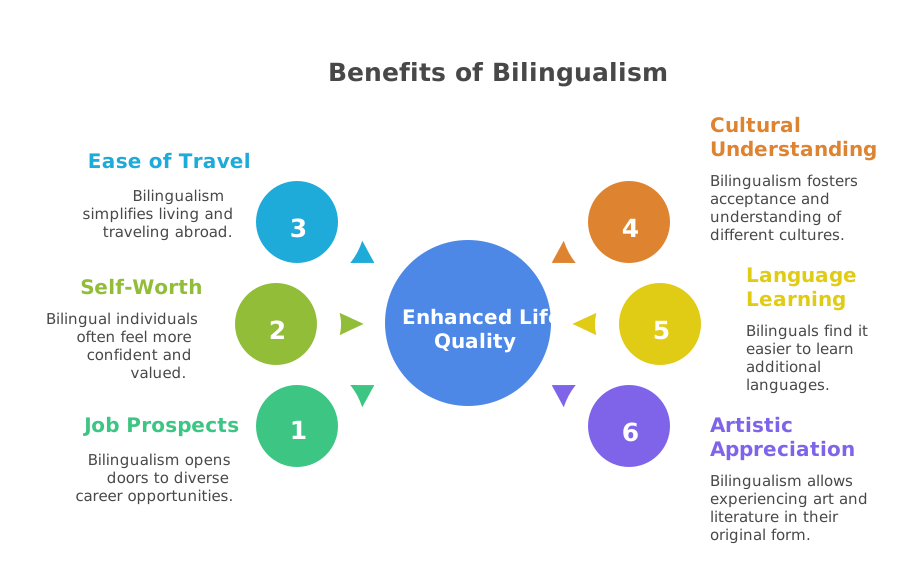
In addition to the cognitive benefits listed above, raising your children to be bilingual gives them skills that will help them in many areas of their future lives.
From encouraging them to be more open-minded individuals to making them more employable, there really is no end to the advantages speaking multiple languages can bring.
Here are just a few examples of what bilingualism offers:
A wider variety of job prospects, with a significant increase in earning power
The ability to learn other languages later on in life with less effort
The chance to experience art and literature in the original language
Tips for bringing up bilingual children
As more people become knowledgeable about the perks of being bilingual, more resources are made available. From books to blogs, there is no shortage of information out there.
We’ve compiled a brief list of some ideas that will help you in your journey to raising bilingual children:
You and your partner may have the same native language, but you can still teach your children your second language, even if you don’t speak it perfectly.
Provide your children with multiple ways to access the second language, whether it’s TV shows, picture books, video games, or audiobooks. Every little helps.
Try not to compare your child’s verbal skills with monolingual children; all children develop at different rates, but it is quite common for bilingual kids to start talking slightly later than their monolingual peers.
Research different methods for bringing up multilingual children, such as One Person One Language, Mixed Language Policy, or Minority Language at Home, and be realistic about what will work for your family.
Find out if there are any local facilities in your area such as playgroups, story time events, or social clubs that focus on the relevant languages.
If it’s a financial possibility for your family, inspire your kids with trips abroad where they can try out their linguistic skills ‘in the real world’.
It’s never too late to start!
Although easier as a child, it’s never too late to learn a new language, and the motivation you feel as an adult will aid you in picking up a new language.
From the traditional classroom and online classes to language acquisition apps and opportunities to work abroad, there are so many ways for you to embrace a new language and culture. It’s not just for kids.
Ever felt like jacking it all in, leaving your 9-5 office job where you’re a slave to someone else? How about booking a one-way ticket out of here, to somewhere hot with great cocktails, sun and sea!?
The big question is how could you make that work financially?
Check out this list of inspiring freelance jobs to give you some ideas and don’t forget to build a resume with an AIresume builder that highlights your skills and experience in your chosen field.
1. Become a freelance translator
Do you speak a second language? You will find yourself in demand as a translator, especially if English is your first language and you are fluent in a second.
In order to become a freelance translator, you will need to get qualifications, such as a degree, but once you have that you can develop a thriving career that you can do from anywhere in the world.
2. Try your hand at stock photography
Have a natural eye and flair for taking beautiful pictures? Use your travel and adventures to capture those special shots which can be listed on stock photography websites and sold for a small price.
Build your portfolio and you can start to have a regular income from something you really love doing.
As inspiring freelance jobs go, being a photographer might seem unrealistic, but once you gain some experience you could specialise as a wedding/baby/party photographer in the area you’re living in if you stay there long term.
It takes more time to build up a reputation and become known, but the pay cheque would be bigger.
3. Develop a teaching talent
Native English speakers can use their skills to teach English online or abroad. Get a TEFL qualification that can be done quickly and reasonably and have fun helping others to learn your language.
This can be a very enjoyable and rewarding job and, due to the high demand for English teachers, there are vacancies literally all over the world. It’s the perfect job for sociable people who love to travel and learn about new cultures.
4. Virtual assistants will always be needed
Are you good at administration?
Organised?
Computer-literate?
This one’s for you; be an online PA.
Perhaps you’ll never meet the person you work for, but you will assist them with any number of varied tasks they need completing and build a relationship on a professional level, all whilst being in completely different locations many miles away.
5. For the expressive writer types
Blog! As a writer, you could build your own blog or write content for someone else. How about becoming a ghostwriter or publishing your own eBook?
If you love expressing yourself on paper, this is an option you will really enjoy.
With a strong online presence being of utmost importance for any business today, this is a great way to offer your skills to help keep any company on the front line.
Don’t have an office? Who needs one? Work from the beach, coffee shop, pool, or a coworking space. The world is your oyster.
Our examples of inspiring freelance jobs can give you the freedom to work anywhere in the world at any time.
You can hold down your job and still have time to soak up the sun and take a dip in the pool, all whilst exploring life overseas! What are you waiting for?
As you prepare for life in a foreign country, you may find yourself in need of professional translation services.
Do you need a document translating but don’t know how you go about it? There are many solutions. Here is a brief guide to the different types of translation service providers, that could help you choose who to entrust your business content to.
Freelance translators
Many translators decide to set themselves up in business as freelancers. These professionals try to carve out a place in the translation market on their own. In this category, you might come across three scenarios:
A freelance translator who will take on your project directly
This professional works alone. You can contact them directly, sending your documents and providing instructions about the translation.
A freelance translator who subcontracts to other colleagues
Some freelance translators, overwhelmed with work, choose to subcontract to trusted colleagues in exchange for a small commission.
They will act as an intermediary, usually proofreading their colleague’s work before sending you the final version.
A freelance project manager
Unlike a translator subcontracting to a colleague, a freelance project manager no longer translates. They act solely as intermediaries. Their address books are long lists of professional translators who specialise in a variety of fields and work in different language combinations.
In this category, two or three people work together to create a small translation agency. They are often former colleagues or collaborators specialising in a particular field who choose to set up their own business.
This is a different way of managing a small agency. Generally, the members of this type of network still produce their own translations. They always proofread all the translations that pass through their hands.
Medium-sized agencies
This type of agency might have five to twenty employees, who will include not just project managers but also specialists in desktop publishing, web formats, and localisation.
They work in the same office, know each other personally and meet every day. Everyone has a specific role and represents a key element of the translation process.
Medium-sized agencies are usually created by professional translators who know their way around the industry and entrust projects to fully qualified independent translators.
Large agencies
Here, at least a hundred employees work together at several offices spread around the world. The scenario here is quite different, and the larger agencies may not even be created or managed by professional translators or people with experience in the industry.
The “business” side tends to take priority over the human aspect and professional fulfilment.
Mega-agencies
Unlike small agencies, these huge corporations, such as SDL or Lionbridge, are real translation factories. Located in many countries, they manage hundreds of projects every day and divide tasks between their large numbers of employees.
They have huge networks of translators working in every conceivable language combination and specialising in particular fields. This enables them to manage many different projects, regardless of the subject.
Translation service providers – it’s up to you!
From freelance translators to mega-agencies, you’re spoilt for choice when it comes to translation service providers! The final decision to entrust your documents to one over another is up to you, depending on your needs and expectations.
Every provider has a different approach, so think about the type of service you want when making your choice.
Have you ever used the services of one of these types of providers? Were you happy with the service? Share your experience with us!
And if you’re looking for a reliable translation agency with experienced native translators, get in touch with BeTranslated today for a free, no-obligation quote.
What training courses are there in Belgium for future translators? As you can imagine, this is not a profession that can be blagged – it requires solid foundations.
In Belgium, translation schools are flourishing all over the country, training hundreds of professional translators every year.
In recent years, translation training in Belgium has become an academic subject taught in universities over five years (a bachelor’s degree in three years and a master’s in two).
This is due to the Marcourt decree, which stipulates that all master’s courses in translation and interpreting should be university degrees.
We have drawn up a list of the main Belgian universities teaching translation.
The Institut Libre Marie Haps trains its future translators and interpreters in the heart of the European quarter. This institution’s reputation for excellence makes it a great choice for students wanting to enter the profession.
The bachelor’s degree in translation and interpreting has recently been taken over by the Université Saint-Louis, though teaching still takes place at the Marie Haps building.
The master’s, meanwhile, is offered at the Louvain-la-Neuve site at the Université Catholique de Louvain (UCL).
ISTI, part of the ULB (Université libre de Bruxelles) since 2015, offers a complete translation and interpreting curriculum in no fewer than 19 languages. As well as European languages, students can choose more exotic tongues such as Chinese, Arabic, Hebrew, and Persian.
Vertaalkunde – Erasmushogeschool Brussel (EhB)
This Flemish university, affiliated with the Vrije Universiteit Brussel (VUB), also offers a course for Dutch-speaking students wanting to specialise in translation.
Students can also opt for this prestigious university. The reputation of the University of Ghent is well-established, and it is considered the best university in Belgium by the Shanghai Ranking.
The Katholieke Universiteit Leuven is another pillar of the Belgian university system. This Dutch-speaking Belgian university is one of the biggest in the country.
The Université de Liège offers a course awarded jointly with the Haute École de Liège. During the bachelor’s course in the first three years, students take classes at both institutions (ULg and HEL), before focusing on either translation or interpreting during their master’s at ULg in the Place du XX Août.
The Mons EII enjoys an excellent reputation in the worlds of translation and interpreting. Students graduating from this school have a solid qualification with which to launch into their working lives.
An unusual feature of this university is that students are offered an introduction to a third foreign language, including Arabic, Chinese, Greek, Hungarian, Swedish, or Norwegian.
The Université catholique de Louvain should not be confused with the Katholieke Universiteit Leuven. The two institutions are entirely separate. Unlike KUL (listed above), UCL is in Wallonia and offers teaching in French. UCL has organised two new master’s courses in translation and interpreting since 2015. The bachelor’s takes place in Brussels at the Marie Haps building (ULB).
Since the start of the 2017-2018 course, the master’s also began to cover Belgian French sign language.
As you can see, would-be translators and interpreters have no shortage of choice.
What do you think of these universities? Do you know of any others that should be added to our list? We are interested in your opinion! You can also take a look at our full list of university translation courses worldwide.
If you’re looking for talented translators such as those who have attended these institutions, look no further than BeTranslated, an experienced translation agency with reliable linguists.
Get in touch today for more information or a free, no-obligation quote.
For many companies or individuals that find themselves in need of a professional translation service, the prospect of choosing the right high-quality translation provider can be rather daunting.
If your content is being translated into a language that you yourself don’t understand, there is an element of trust, as you aren’t able to verify the quality of the work yourself.
The abundance of information online can be overwhelming for those working with translators for the first time.
Perhaps you’ve come across terms like CAT tools and localisation while browsing through translation agency websites and been left feeling confused, but all is not lost!
Our simple guide to what to look for when hiring a translation service will help you find the right translator for you.
Be specific about your language requirements
Let’s start with language combinations. Many translation agencies specialise in specific languages, such as European languages like French and Italian or Asian languages like Korean and Japanese, whilst others that have a larger pool of translators offer a seemingly endless list of language combinations.
It is crucial that your translator is specialised in the right regional dialect for your needs. For example, if your company is branching out into the Latin American market, working with European Spanish translators is not going to be appropriate.
Be specific with your translation agency about the regional details of your target audience, and make sure that they have linguists who are experienced with the dialects your project requires.
Look for translators specialised in the appropriate subject
Linguistic knowledge is just one piece of the translation puzzle; your translator should also be knowledgeable about the subject of the text to be translated.
If you need a contract translated, you should work with a legal translator experienced in contracts, whereas a marketing translator would be a more suitable choice for your publicity content.
Working with a specialised translator will ensure you receive a high-quality translation.
When researching translation service providers, focus on those that specialise in the type of translation you need, and feel free to ask them about their previous clients, which will give you a better idea about the kinds of translation they have experience doing, and the profiles of their translators.
Read reviews with a critical eye
Once you’ve narrowed your search down to translation agencies that are experts in your subject area and language combinations, it’s time to focus on their reputations.
Take a good look at their website and social media pages, particularly focusing on customer reviews and feedback. Read the reviews thoughtfully, with a clear idea of the kind of company you’re looking for.
Also, pay attention to the types of clients they have worked with; are they similar to your company?
Approaching this information with a clear idea of your own needs will make it much easier to process what is relevant to you and your needs.
Consider requesting a sample translation
Providing a translation agency with a short sample text (around 300 words is standard) for them to translate, which you may or may not be asked to pay for, is a great way of checking the quality of the work and confirming if they are the right fit for your translation needs.
Be realistic with what to expect from a free test translation; don’t expect a translator to translate pages and pages of text for free, especially if the job on offer is a small project.
That being said, many translators are happy to provide short samples, and it’s a useful step in finding the right high-quality translation service.
Be clear on the service that you expect
Ask for details on what the translation company offers, and be clear about what you need. Will you require extra services such as proofreading or localisation?
Don’t be afraid to ask the agency for details of their service, for example, is proofreading performed by a second qualified translator?
This is recommended as human error is natural and the more eyes on a text the better.
The bottom line is that clear communication will lead to a better working relationship and, ultimately, a better final product.
As an experienced translation agency with highly-qualified translators located around the globe, BeTranslated could be the right translation service provider for you.