by Michael Bastin | 13 Feb, 2023 | Human translation, Machine Translation, Translation tools
Translation Industry Trends in 2026
How AI and human expertise are reshaping professional translation
The debate over whether AI will replace human translators has shifted. It’s no longer about replacement—it’s about collaboration. AI has made remarkable advances, yet the need for human expertise has become more refined, not less.
Nimdzi, one of the industry’s leading research firms, estimates the market reached $71.7 billion in 2024 and projects growth to $75.7 billion in 2025. This growth is driven by digital interconnectedness and demand for culturally nuanced communication across markets in Europe, Asia-Pacific, North America, and emerging economies.
Today’s businesses—from multinationals like Siemens, Nestlé, and Samsung to fast-growing startups—operate in a global digital ecosystem where the ability to communicate across languages and cultures is essential for growth.
AI translation: from novelty to necessity
Machine translation has evolved from experimental tool to industry standard. Systems like Google Translate, DeepL, Microsoft Translator, and Amazon Translate have achieved remarkable fluency through several key developments:
- Transformer-based neural machine translation (NMT): Large language models (LLMs) like GPT-4, Claude, and Gemini understand context and nuance far better than earlier statistical models
- Zero-shot translation: Systems that translate between language pairs they were never explicitly trained on—useful for low-resource languages like Welsh, Basque, or Swahili
- Adaptive machine translation: AI that learns from translator corrections and client feedback, improving output over time
- Multimodal AI: Systems processing text, audio, and images simultaneously—think real-time subtitle generation or translating text within photographs
Why human translators still matter
Despite these advances, human expertise remains irreplaceable. AI handles volume and speed, but professional translators provide what machines cannot:
- Cultural intelligence: Understanding idioms, humour, and references that don’t translate literally—a British understatement won’t land the same way in Brazilian Portuguese
- Transcreation: Adapting marketing copy, slogans, and brand messaging so they resonate emotionally in the target market
- Ethical judgment: Navigating sensitive topics—medical information, legal documents, religious texts—with appropriate care
- Strategic alignment: Ensuring translations support broader business goals, tone of voice guidelines, and brand positioning
Key trends shaping the translation industry
Augmented translation workflows
Translation management systems (TMS) like SDL Trados, memoQ, Phrase, and Smartling now integrate AI to predict terminology, suggest translations from translation memory, and automate repetitive formatting tasks. This lets translators focus on the work that actually requires human judgment. Increasingly, the bespoke integrations that connect these platforms to business systems are built by specialist software developers like Globaprom.
Specialisation over generalisation
As AI handles general content, human translators are focusing on specialist domains: legal translation for international contracts and litigation, medical translation for clinical trials and patient documentation, financial translation for IFRS reporting and regulatory filings, and creative localisation for gaming, film, and advertising.
Real-time localisation
Live events, streaming platforms like Netflix and Disney+, and immersive experiences in VR and AR are driving demand for real-time localisation. Subtitling, dubbing, and voice-over services have become faster and more sophisticated, with AI-assisted workflows cutting turnaround times dramatically.
AI governance and quality standards
Organisations are establishing frameworks to ensure AI translation tools are used responsibly. This includes addressing bias in training data, preserving linguistic diversity for minority languages, and maintaining compliance with ISO 17100 quality standards for professional translation services.
The modern translation workflow
The most effective translation processes now combine AI efficiency with human expertise:
- Machine translation first pass: NMT systems like DeepL Pro or Google Cloud Translation generate initial drafts at speed
- Human post-editing: Translators refine the output for fluency, cultural fit, and emotional resonance
- Subject matter expert review: Specialists in law, medicine, finance, or technology verify terminology and accuracy
- Quality assurance: Final review combining automated QA tools with human proofreading
- Feedback loop: Corrections feed back into translation memory and, where appropriate, improve the AI model
Looking ahead
The translation industry has embraced a collaborative model where AI and human expertise complement each other. AI handles scale, speed, and pattern recognition. Humans provide cultural intelligence, creative adaptation, and ethical judgment.
The organisations getting the best results aren’t those replacing translators with AI—they’re the ones integrating both strategically. The future of translation isn’t human versus machine. It’s human and machine, working together.
by Michael Bastin | 10 Oct, 2022 | Communication, Audio Blog, Good to Know
The biggest improvement in the movie industry has been breaking the language barrier: we were no longer limited by foreign languages in films, meaning that we could watch almost anything we wanted to.
This made people appreciate film-making more than ever because each country and culture added something unique to the table.
French, American and Chinese films took the world by storm, and with that, movie dubbing and subbing became a must for a movie to gain an audience.
Dubbing is the process where the original script sound is replaced with words from a different language. It is a common practice in animated movies, for example, as well as in news and documentaries.
On the other hand, subbing is just the transcribed text placed at the bottom of the screen so that people can read what the characters are saying.
Both techniques seem easy to perform, but they’re more complicated than it looks.
Let’s find out more about how dubbing is done.
Scripting and timing
To get started with movie dubbing, a translator is needed to translate the original text into the new language.
This is the trickiest task because all languages have different sayings and meanings, so the text must be thoroughly checked before voice actors are involved.
The voice of the actors speaking that foreign language will be recorded and then audio-edited to the original film.
Besides being a translated version, it’s also an adaptation of the original, where tone and emotion are crucial factors.
Each language is different and voice actors must replicate those feelings relevant to their native country, which is not an easy task.
One of the biggest challenges of dubbing is timing.
First, a translator needs to be thoughtful about the sentence’s duration and not make it too long because the voice actor needs time to pronounce everything properly.
Plus, the words need to be fitted to the visuals that appear on the screen—work that takes hours to complete.
Casting and recording
The next challenge is finding the perfect person to fit the character and the movie’s vibe.
Voice actors should first mirror the tone and inflection used by the performer from the original film. You might notice these details even in the way voice actors speak in animated movies for children.
The emotion is still there, including the excitement, the singing, and the sadness.
Next is voice recording.
There are two styles: the out-loud reading of the script by actors while they watch the original footage.
This is the standard method, where there will be three beeps, with the performers saying their lines at the fourth beep.
But to get there, performers go through rigorous training.
For example, a British voice actor will study a variety of acting approaches, like Stanislavski’s system, Strasberg’s method, and Meisner’s technique.
Then there’s the alternative recording method, used primarily in France and Canada, where actors read the lines of dialogue at the bottom of the screen while the movie plays.
Editing
Getting to the most tedious work, editing, is converging the new dialogue tracks and recording with the original movie sound.
It all starts by dismantling the original voices from the main soundtrack and creating a “music and effects track” (M&E).
After the foreign dialogue is recorded, the editors will fit it in the right places of the M&E to blend with the sound.
The audio post-production is done in three distinct steps:
- Editing everything from the speech to the music and live action. This is when the audio takes are chosen and combined and the music is cut to fit as close as possible without affecting the sound quality.
- Mixing music, adding extra sound effects, and balancing natural speech. Editors will use audio equalisers, dynamic compressors and noise reduction features.
- Mastering the sound by levelling the video so that everything sounds equally good. Editors must consider the devices people are playing the sound from, and given that they’re mostly smartphones or laptops, they should master the sounds accordingly.
Why movie dubbing matters
Movie dubbing can be easily underestimated by people who watch subbed videos and movies.
That’s because if you are used to a certain type of voice and talking style, it may sound weird to hear other voices perform.
But subbing takes away the essence of the movie. Besides the fact that you need to pay attention to the text and the screen, it may be tiring to follow everything that is happening.
A study by the British Film Council in 2010 concluded that fans of mainstream cinema prefer dubbing, while people interested in foreign languages want to see a subbed film.
In the end, it’s a matter of taste, but watching a subbed video might alter your experience, which lowers the movie’s quality.
However, there’s a downside to dubbed movies too.
If you want to learn a foreign language, it’s more challenging to do so by watching dubbed movies than subtitled ones.
But dubbing can change the film by improving the sound effects and the dialogue, regardless of the conditions in which the audio was recorded.
Moreover, it can increase the reach of a film project since it can be released internationally, and people can view it in their native language.
Let’s take the example of Japanese animations called anime.
The language they’re recorded from the start is quite difficult, but as soon as voice actors started dubbing anime, their popularity rose immediately worldwide, and now everyone knows about Naruto, for example.
Given that the mouth’s movements don’t have to line up with the audio, voice actors are not that limited when it comes to performing.
Wrapping up
Dubbing and subbing movies and video animations are the most remarkable changes in the cinematography industry.
Although they seem easy to do, each process is followed by many challenging steps in order to achieve the perfect audio.
Plus, watching dubbed and subbed movies can help people learn new languages better, as they get to see how voice actors interpret and talk.
by Michael Bastin | 12 Jul, 2022 | Translation services, VPNs
Securing data using a virtual private network (VPN), is important in the translation industry.
Digital technology has made communication services easier to provide and access on a global scale.
For translators, these tools have allowed language and interpretation experts to localise messages, media and content for business people and media audiences in their home language, sometimes in real time.
As beneficial as this can be, one of the drawbacks is that supplying services using the internet can be fraught with security risks.
It can be a major disadvantage for translators, handling private data and even processing online payments for their services.
Fortunately, VPNs were created as a solution to address many of these concerns.
Thus, if you work in translation and interpretation, here’s how VPNs can be an advantage to your service.
Network Security
Privacy and anonymity are key factors in why working professionals choose to use VPNs. They are also crucial for translators involved in exchanging crucial language information during international conflicts and civil unrest with the outside world.
They can interpret, translate, dub, and send written accounts to journalists, news media, criminal courts, and military allies that influence political outcomes.
VPNs are also useful for translators who work for international organisations that need real time translation using earpieces and live-streaming media.
In this case, VPNs for Kodi can be used to access and translate across live media without slowing down internet speeds.
Just as important, VPN’s privacy can prevent them from being traced later as it won’t collect and store browsing information.
Thus, VPN obscurity can keep them safe and allow them to continue providing translations.
Bypass Geo-blocking
As a translator, providing services across different cultures and countries, it’s essential for their income to remain accessible to clients around the world.
However, this isn’t always the case, as many find themselves unable to create profiles on freelance job boards because they’re blocked or restricted within a specific region.
Additionally, many websites with language knowledge and online resources that translators need to access for research purposes might also be blocked.
Many companies do this to comply with legal contracts and copyright laws in their country.
This is where VPNs can be beneficial to translators.
These virtual private networks have the ability to mask an IP address and bypass this geo-blocking, as the real location can’t be identified by the website they’re trying to access.
Thus, with the location changed to a permitted region, they’ll be able to advertise their services and reach clients anywhere in the world.
Prevent Data Breaches
Many freelance translators often work with companies that need sensitive and non-disclosed data and information translated for business purposes.
These could be commercial translations for global financial and trade institutions, pre-patented product information or government and diplomatic intelligence that needs translating from one language to another.
For translators to provide their language services, this sensitive information needs to be transferred digitally through file sharing.
However, this poses a big security risk.
For this reason, translators should ideally use a VPN to secure the network and encrypt data.
This is especially necessary if translators send and receive information from unsecured public network access points.
VPNs are therefore a useful protective measure to safeguard against potential cybercriminals who could attempt to hack the network, plant malware or breach data.
The VPN can then scramble the data so that it can’t be decoded, keeping it discrete.
In any case, you can use a data breach tracker and control the information to stay secure.
Accessibility When Travelling
Translators often have to travel abroad to provide in-person services for multilingual people and events.
As such, they need to take digital devices with them to work on, such as smartphones, tablets, and laptops.
The one issue with this is that when translators access accounts from different regions, it could be picked up and flagged by security monitoring software from banks, internet browsers, company websites, and the digital device itself.
This could be marked as suspicious activity and make it difficult and frustrating to access necessary accounts.
Thus, when using a VPN during travel, translators can avoid being locked out of corporate profiles such as cloud storage data that use authorisations necessary for doing their job overseas and any other remote working areas.
The VPN can set your location connection to your regular home address to prevent any security warnings from popping up.
Conclusion
VPNs offer immense benefits for translators who use the internet to provide their service. These private networks are useful for data privacy and encryption, corporate information and network security, anonymity, and easier accessibility when travelling.
Their use to generate a private network connection has assisted workers in the translation and interpretation industry in conducting their work in a safer online environment.
Additionally, they give freelance translators better opportunities to acquire more international clients and cultural insights for language accuracy and knowledge building that would’ve otherwise been restricted to them.
These are the key reasons why VPNs are essential to the translation service industry.
by Michael Bastin | 23 May, 2022 | Interpreting
You’ve just graduated with an interpreting degree, and you’re now ready to apply to different companies and organisations for a full-time job, with just an interview standing in your way before beginning your professional career.
You have thought through everything about this next step, and the interpreting world is no longer a step into the unknown for you.
You may have even bought yourself a brand-new notepad for your future note-taking.
Let’s take a look at that in more detail. Here is a short summary of the most important hints and tips to keep in mind as you start your note-taking career. Let’s get straight into it.
Interpreting: a renowned profession full of twists and turns
When you think about it, what better job is there than an interpreter? Bringing people of different languages and cultures together.
Helping people communicate through a language barrier.
And most of all, communicating the messages and knowledge of one person or group to another. These among many others are the main motivations for interpreters to throw themselves into their profession.
The extremely varied working methods of an interpreter gives this job a real sense of achievement for people who enjoy handling multiple languages.
From dentists’ conventions in Warsaw, to presentations at film festivals or even translating official UN speeches, the range of possibilities for an interpreter is vast.
It is said that it is impossible for an interpreter to be bored, as they are continually looking for new sectors to explore.
This is why there are so many aspiring candidates trying to make it in the interpreting world, but not everyone can be in Nicole Kidman’s shoes.
It’s an expensive and competitive sector where demand is high, so patience is key.
Consecutive interpretation: a linguistic procedure which is incredibly complex
If you are a regular reader of our posts, you will know that there are several types of interpretation.
- Simultaneous interpretation: As its name suggests, it is translating the speech of a speaker into the target language at the same time as they are speaking. This type of interpretation requires the use of state-of-the-art equipment: sound-proof booth, high-performance headsets, top quality microphones, excellent sound diffusion space, headphones, etc.
- Consecutive interpretation: In this case, the speaker says a sentence or idea before the interpreter translates everything that was said. Well, not exactly everything. The idea of this type of interpretation is to take notes efficiently to be able to capture the main ideas of what was said. This is where it gets the reputation for being a highly complex job. Consecutive interpretation not only requires excellent linguistic skills, but also a strong ability to listen, take notes, summarise and concentrate.
The importance of taking notes in consecutive interpretation
As you now know, it is vitally important that interpreters are experts at note-taking if they are to accurately convey the key points of a speech.
Our specialists here at BeTranslated have come up with seven key tips for effective note-taking:
- Do not write full sentences. Only useful and relevant words are needed
- Note down the structure of what is being said as you go along (titles, subtitles, etc.)
- Write down the more complex things that can be tricky to remember (numbers, percentages, etc.)
- Use abbreviations for words that come up a lot, as this saves a lot of time
- Do not go into secretary mode and start writing down absolutely everything
- Ensure your notes are clear, making them as easy as possible to read
- Use a note-taking application like Bear, Evernote or Notion
Are you in search of an experienced professional interpreter or translator?
Contact our translation services today to get a free, no-obligation quote.
by Michael Bastin | 18 Oct, 2021 | Languages, Language learning
If you’re looking for an introduction to Western European languages, this article is a great beginner’s read.
Within Europe, hundreds of languages exist, some of which are widely spoken worldwide.
In this article, we’ve created a brief overview of Western European languages and their history and prevalence within Europe and worldwide.
Let’s take a closer look at this fascinating language group.
Europe’s Languages
Within Europe, there are only 24 official languages, despite there being hundreds of additional languages actually spoken.
That number, of course, is low compared to other continents where sometimes thousands of languages are spoken.
However, the languages of Europe are incredibly diverse and influential, many with very interesting roots.
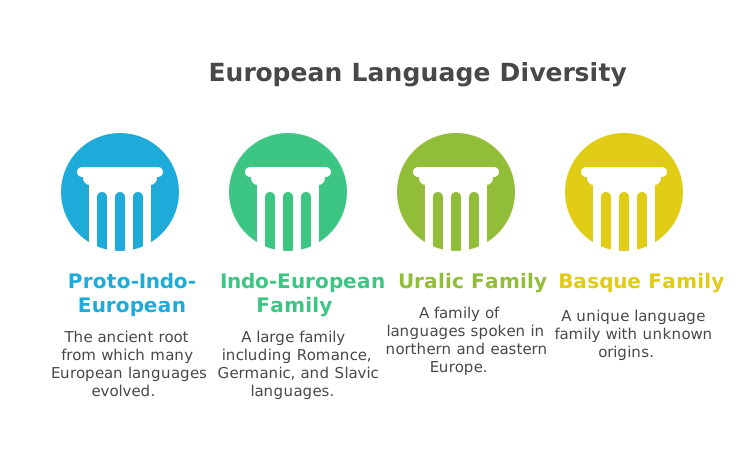
Looking back, the majority of European languages that continue to exist today came from Proto-Indo-European, which is the language that the Indo-European language family came from.
The Indo-European language family is large, containing the Romance, Germanic, Armenian, Celtic, Hellenic, Slavic and Baltic languages.
The area from which these languages originated is the subject of much debate.
In addition to Indo-European, Uralic, and Basque language families exist in Europe and within those families are the majority of European languages.
Romance Languages
Romance languages include a wide range of different languages, such as Catalan, Romanian, Spanish, Portuguese, French, and Italian.
Germanic
English
is part of the Germanic group of European languages and has 1.35 billion speakers worldwide, including those who speak it as a first or second language fluently.
Germanic also includes languages such as Norwegian, Swedish, Bavarian, Dutch, and Afrikaans.
Slavic
The Slavic group of languages includes Slovak, Polish, Russian, Czech, and Bulgarian, to name a few. Multiple Slavic languages are spoken worldwide, especially Russian, which has over 250 million speakers across the globe.
Baltic
Baltic languages include Lithuanian and Latvian (Lettish), as well as multiple ancient extinct languages, including Prussian, Selenian, and Selonion.
Celtic
Celtic languages include Cornish, Gaelic, Breton, and Welsh. They are incredibly old languages that come from one Brittonic language that existed in the Iron Age.
Despite these languages being so old, some are still used commonly today, including Welsh, which is still spoken by nearly 30% of the population of Wales.
Hellenic
Hellenic includes Greek, the only language of this group within the Indo-European group of languages.
Albanian
Albanian is alone in its group within the Indo-European group of languages.
Armenian
Armenian is spoken by a high proportion of people living in Armenia, as well as people who live in Russia and Iran.
It’s also important to acknowledge the two other language groups of Europe – Basque and Uralic. Uralic includes Finnic languages and Urgic languages, whilst Basque is a language in its own right spoken in specific areas, such as Northern Spain.
Western European Languages
Western European languages contain a wide variety of languages which are mostly Romance languages from South Western and Central Europe and Germanic languages from Northern Europe, the British Isles and Central Europe.
Various languages are classified as Western European languages, including:
- Irish
- Scots
- Gaelic
- Manx
- Welsh
- Breton
- Greek
- Cornish
- Finnish
- Hungarian
- Maltese
- Basque
- French
- Portuguese
- Italian
- Spanish
- Dutch
Some of the most commonly spoken Western European languages are Spanish, Italian, French, Dutch and Portuguese.
These are the languages you may have considered learning if you want to travel around Western Europe, and you may have studied one or more of them at school.
Let’s take a closer look at these common Western European languages:
Spanish
There are around 460 million native Spanish speakers worldwide. Aside from Spain itself, America has the highest population of Spanish speakers in the world.
The language has been around for over 1,500 years and has its origins in Latin.
Unlike Classical Latin which we still see in the written word, the Spanish we see today is called Castilian Spanish.
This type of Spanish has an authoritative source called the Royal Spanish Academy, which was founded in 1713 to standardise this type of Spanish, produce reference dictionaries and keep official Spanish language dictionaries updated.
Italian
Italian
has around 67 million native speakers, and it is spoken in Italy, Switzerland, San Marino and Vatican City.
The Italian language comes from Latin and developed over a long period of time following the Roman Empire falling in the 5th century.
While there are Italian documents dating as far back as 960 CE, the first real evidence appeared at the beginning of the 13th century.
Many poems and pieces of writing appeared during this time.
Modern Italian is formed from the Tuscan dialect, although multiple other influences exist and contributed to the Italian we know today.
French
Around 88% of the population of France speak French as their native language. French is also widely spoken across many countries, including 29 with it as their official language.
The French language we know today has origins in a part of Western Europe that no longer exists, called Gaul.
The language of that region has little impact on the actual French language we speak today, but over 100 words from that language went into the Latin language; those words then came into the French language and 70 are still used today.
More complex historical events have influenced the development of French, but its Latin roots are the reason many English speakers feel that it is easier to learn French than other languages.
The same could be said for other Romance languages, which all descend from Latin.
Dutch
There are over 23 million speakers of Dutch worldwide.
It is also spoken in various other countries, including Aruba, Curaçao and St Maarten, where it is an official language.
The Dutch language spoken today was part of Old Franconian during medieval times.
Old Dutch then started to develop and branch off from Old Franconian, eventually becoming the main language in areas of Europe that we now know as Northern Belgium and the Southern Netherlands.
Old Dutch eventually turned into Middle Dutch, which then changed into various different dialects.
It was in the 17th Century that the language was standardised by Protestant authority figures within the Dutch Republic as they created a Dutch edition of the Bible.
Portuguese
Portuguese is spoken by over 275 million people in the world, with most speakers of the language in Brazil.
The language started on the Western Iberian Peninsula as Latin, which was introduced when Romans took over the area.
Once the Roman Empire collapsed, Germanic communities took over the area, and Latin developed into Galician-Portuguese because that part of the world was known as Galicia at the time.
Once Galicia was merged with Spain, Galician and Portuguese became two separate language branches, and Portuguese then developed into the language we know today.
Speak to a professional
If you’re looking to learn more about Western European languages as part of a business expansion, then consult an expert.
As we’ve outlined above, there are so many languages and variations within the broad spectrum of European languages.
Therefore, if you’re looking to put together new marketing materials, you’ll need to make sure your videos and voice-overs are accurate and relevant to your target audience.
Otherwise, have fun exploring and learning more about the rich culture and history of European languages.
Don’t hesitate to contact BeTranslated for any professional language services that you may require for your business or your personal needs.
