How cultural context shapes meaning, tone, and accuracy across languages
When we need to translate something, most of us reach for Google Translate, assuming it will do the job.
But Google often mistranslates sentences and misses crucial cultural and linguistic nuances.
Cultural sensitivity matters in translation. Here’s what you need to know.
How culture changes word meanings
As Europeans travelled west to conquer the New World, they brought their languages with them. That’s why people in the Americas speak English, French, Spanish, and Portuguese.
However, these languages have diverged considerably over time.
Take French as an example. France remains the centre of the French language, whilst people in Quebec, Canada, have spoken it since Jacques Cartier arrived in 1534.
Almost 500 years later, Canadian French differs markedly from European French in usage and accent. Understanding French culture when learning French is therefore essential.
This can lead to serious misunderstandings when a word carries completely different meanings in each region.
Consider the word “gosse,” which means children in France. In Quebec, the same word refers to male genitalia.
Without understanding this cultural distinction, you could either make people laugh or deeply embarrass them.
What is cultural sensitivity, and why does it matter in translation?
Every society has its own cultural sensitivities. Although these are weakening in an increasingly globalised world, they still exist and must be considered when you translate into another language.
Cultural sensitivity encompasses norms, beliefs, values, customs, and behaviours.
Without understanding these, conveying a message in another language becomes difficult—or worse, creates deep misunderstanding.
Communication style matters too. When interpreting live, you may need to maintain eye contact with one person, whilst the same behaviour would be considered impolite in another culture. Your dress may also cause offence depending on religious beliefs.
A single word can change the meaning of an entire sentence, even if technically correct. The message may come across as offensive when it wasn’t intended to be. And whilst you can claim misinterpretation, words are difficult to take back once spoken—or worse, written.
Demonstrating cultural awareness generates respect. In business, such attention to detail can forge strong trading relationships that last for years.
How to ensure cultural sensitivity in your translations
A translator’s learning never stops. Working with more experienced professionals helps build cultural knowledge for the specific countries where you operate.
Do your research
Research should always be your first step when working in a new country. There are countless ways to learn about cultures today, starting online. Speaking with local people is particularly valuable for understanding what you can and cannot say.
Watch for local dialects
In some countries, dialects play a significant role in communication. Italy is a prime example, where each region—sometimes each city—uses a different dialect. A translator must account for this.
Anyone working in translation needs to understand cultural sensitivities to convey meaning accurately. That’s why it’s better to specialise in a few countries rather than spread yourself too thin.
If you’re looking for an introduction to Western European languages, this article is a great beginner’s read.
Within Europe, hundreds of languages exist, some of which are widely spoken worldwide.
In this article, we’ve created a brief overview of Western European languages and their history and prevalence within Europe and worldwide.
Let’s take a closer look at this fascinating language group.
Europe’s Languages
Within Europe, there are only 24 official languages, despite there being hundreds of additional languages actually spoken.
That number, of course, is low compared to other continents where sometimes thousands of languages are spoken.
However, the languages of Europe are incredibly diverse and influential, many with very interesting roots.
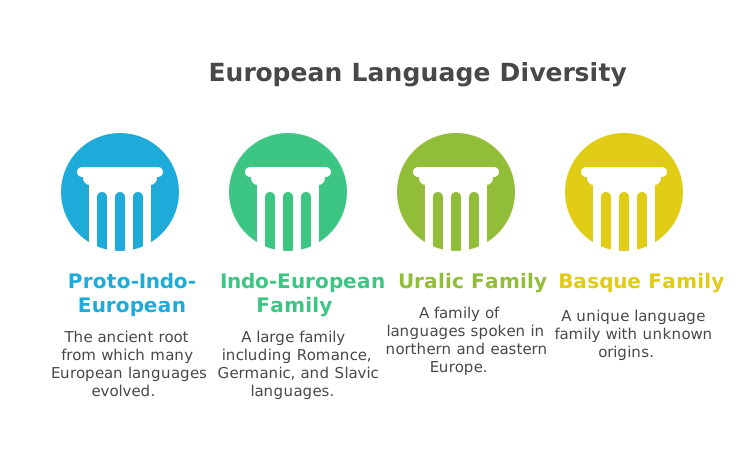
Looking back, the majority of European languages that continue to exist today came from Proto-Indo-European, which is the language that the Indo-European language family came from.
The Indo-European language family is large, containing the Romance, Germanic, Armenian, Celtic, Hellenic, Slavic and Baltic languages.
The area from which these languages originated is the subject of much debate.
In addition to Indo-European, Uralic, and Basque language families exist in Europe and within those families are the majority of European languages.
Romance Languages
Romance languages include a wide range of different languages, such as Catalan, Romanian, Spanish, Portuguese, French, and Italian.
is part of the Germanic group of European languages and has 1.35 billion speakers worldwide, including those who speak it as a first or second language fluently.
Germanic also includes languages such as Norwegian, Swedish, Bavarian, Dutch, and Afrikaans.
Slavic
The Slavic group of languages includes Slovak, Polish, Russian, Czech, and Bulgarian, to name a few. Multiple Slavic languages are spoken worldwide, especially Russian, which has over 250 million speakers across the globe.
Baltic
Baltic languages include Lithuanian and Latvian (Lettish), as well as multiple ancient extinct languages, including Prussian, Selenian, and Selonion.
Celtic
Celtic languages include Cornish, Gaelic, Breton, and Welsh. They are incredibly old languages that come from one Brittonic language that existed in the Iron Age.
Despite these languages being so old, some are still used commonly today, including Welsh, which is still spoken by nearly 30% of the population of Wales.
Hellenic
Hellenic includes Greek, the only language of this group within the Indo-European group of languages.
Albanian
Albanian is alone in its group within the Indo-European group of languages.
Armenian
Armenian is spoken by a high proportion of people living in Armenia, as well as people who live in Russia and Iran.
It’s also important to acknowledge the two other language groups of Europe – Basque and Uralic. Uralic includes Finnic languages and Urgic languages, whilst Basque is a language in its own right spoken in specific areas, such as Northern Spain.
Western European Languages
Western European languages contain a wide variety of languages which are mostly Romance languages from South Western and Central Europe and Germanic languages from Northern Europe, the British Isles and Central Europe.
Various languages are classified as Western European languages, including:
Irish
Scots
Gaelic
Manx
Welsh
Breton
Greek
Cornish
Finnish
Hungarian
Maltese
Basque
French
Portuguese
Italian
Spanish
Dutch
Some of the most commonly spoken Western European languages are Spanish, Italian, French, Dutch and Portuguese.
These are the languages you may have considered learning if you want to travel around Western Europe, and you may have studied one or more of them at school.
Let’s take a closer look at these common Western European languages:
Spanish
There are around 460 million native Spanish speakers worldwide. Aside from Spain itself, America has the highest population of Spanish speakers in the world.
The language has been around for over 1,500 years and has its origins in Latin.
Unlike Classical Latin which we still see in the written word, the Spanish we see today is called Castilian Spanish.
This type of Spanish has an authoritative source called the Royal Spanish Academy, which was founded in 1713 to standardise this type of Spanish, produce reference dictionaries and keep official Spanish language dictionaries updated.
has around 67 million native speakers, and it is spoken in Italy, Switzerland, San Marino and Vatican City.
The Italian language comes from Latin and developed over a long period of time following the Roman Empire falling in the 5th century.
While there are Italian documents dating as far back as 960 CE, the first real evidence appeared at the beginning of the 13th century.
Many poems and pieces of writing appeared during this time.
Modern Italian is formed from the Tuscan dialect, although multiple other influences exist and contributed to the Italian we know today.
French
Around 88% of the population of France speak French as their native language. French is also widely spoken across many countries, including 29 with it as their official language.
The French language we know today has origins in a part of Western Europe that no longer exists, called Gaul.
The language of that region has little impact on the actual French language we speak today, but over 100 words from that language went into the Latin language; those words then came into the French language and 70 are still used today.
More complex historical events have influenced the development of French, but its Latin roots are the reason many English speakers feel that it is easier to learn French than other languages.
The same could be said for other Romance languages, which all descend from Latin.
Dutch
There are over 23 million speakers of Dutch worldwide.
It is also spoken in various other countries, including Aruba, Curaçao and St Maarten, where it is an official language.
The Dutch language spoken today was part of Old Franconian during medieval times.
Old Dutch then started to develop and branch off from Old Franconian, eventually becoming the main language in areas of Europe that we now know as Northern Belgium and the Southern Netherlands.
Old Dutch eventually turned into Middle Dutch, which then changed into various different dialects.
It was in the 17th Century that the language was standardised by Protestant authority figures within the Dutch Republic as they created a Dutch edition of the Bible.
Portuguese
Portuguese is spoken by over 275 million people in the world, with most speakers of the language in Brazil.
The language started on the Western Iberian Peninsula as Latin, which was introduced when Romans took over the area.
Once the Roman Empire collapsed, Germanic communities took over the area, and Latin developed into Galician-Portuguese because that part of the world was known as Galicia at the time.
Once Galicia was merged with Spain, Galician and Portuguese became two separate language branches, and Portuguese then developed into the language we know today.
Speak to a professional
If you’re looking to learn more about Western European languages as part of a business expansion, then consult an expert.
As we’ve outlined above, there are so many languages and variations within the broad spectrum of European languages.
Therefore, if you’re looking to put together new marketing materials, you’ll need to make sure your videos and voice-overs are accurate and relevant to your target audience.
Otherwise, have fun exploring and learning more about the rich culture and history of European languages.
Don’t hesitate to contact BeTranslated for any professional language services that you may require for your business or your personal needs.
Employing multilingual people or staff with a knowledge of foreign languages is crucial for companies that are working at an international level.
Having a good knowledge of English, for example, is a significant advantage in the workplace as in many locations around the globe English is considered a lingua franca when working with overseas clients.
With that said, the ability to master additional languages could be just the thing that gives your business the competitive edge.
This is particularly important when doing business in regions where knowledge of English is not a given.
Consider hiring staff that are proficient in languages that are relevant to your sector, whether that’s Spanish, French, Chinese, Korean or any other language.
The benefits of speaking your clients’ native language
Your client will view your dedication to having invested the time to learn their language as a long-term commitment.
Furthermore, this will reward you with long-standing relationships and loyalty from your customers. It’s also worth noting that having an understanding of the language used in your new market will enable you to acquire far better insights into the local character, customs, and beliefs.
Multilingual employees help foster strong relationships with clients
Employing multilingual people can bring great benefits to your company. These employees will enable your business to seamlessly connect with foreign customers and other local organisations.
The ability to provide your services in multiple languages gives clients a strong impression of your company; it will build greater trust and appreciation for your services, resulting in strong relationships with your clients.
These relationships can be translated into significant profits, meaning hiring multilingual employees is a sensible financial decision.
What if your team isn’t multilingual?
Not all companies have the luxury of employing multilingual people, which can put them at a disadvantage. But never fear!
By hiring a professional translation service, your company can gain many of the benefits of multilingual employees, and more besides.
Translators can be used for a wide variety of communicative tasks, from informal communications between companies to legal contracts and marketing campaigns.
Contracting professional translators guarantees that any content you produce in the target language is of the highest quality.
BeTranslated’s vast network of expert translators could be just the thing your company needs to facilitate its international expansion.
Get in touch today for more information or a free, no-obligation quote.
The word ‘universal’ describes something that is all-encompassing, such as today’s business world.
Learning a new language abroad will be key, as business takes place across many languages, not just one single means of communication. Here is how you can avoid this sticking point.
For this reason, limiting yourself and your business to what you can speak means you’d only have a smaller scope of operation.
Thankfully, languages can be learned, and with modern methods, you’ll quickly pick up on the garb of a foreign tongue.
Learning a new language abroad is a gateway that creates a connection that makes things run smoothly.
Whether that’s sitting in a classroom, using an app or a blog, the practical purposes a new language serves to solve many problems.
These tips will help you when learning a new language abroad, whatever the business trip you embark on. Even a packed schedule can leave room to unwind — a few hours by the coast with a board from Matosurf makes the perfect reset.
Enrol in a language class
This is one of the best and foolproof tips if you’re going to grab on a language quickly enough.
A basic knowledge of the structure, grammar, and how words are pronounced sets the tone for better communication.
You don’t have to know everything to at least say ‘hi’ or effectively pass off a little message in a new language.
Further, enrolling in a language class means you see the bigger picture and the advantages associated with starting off on the right foot with language skills, particularly if your line of business is novel to you.
Language classes do need a certain degree of commitment and attention from you, meaning you will lose some valuable time, but on the whole, it’s worth it if your business must break new ground.
Mimic and imitate
If you’ve felt comfortable watching a Spanish, Chinese or Italian sitcom and didn’t have an issue following (with subtitles, of course), perhaps picking up some few lines to mimic would help.
Sometimes, lines get stuck in the mind, and you find yourself eager to learn more. It’s the same on the business front.
When you meet clients and other business partners, listen with keen interest and observe how they use words, phrases, and the gestures that follow.
Chances are you’ll pick up on some familiar words and try them out at a later time.
This way, you’re testing your mental ability to grasp essential parts of the new language and making an effort that is bound to pay off.
A drawback of mimicking is that you may get lost in the context of what’s being said.
However, an attempt to speak what you’ve heard or learned upgrades your personal network, which helps your business concerns.
Resist the urge to speak your language
It’s definitely one to watch out for. Even though it does help you escape a few sticky situations, replying in your host’s native language further strengthens your resolve to learn it.
Again, you might sound like an insect close to a well-lit bulb, but it’s better than being too comfortable with what you already know.
Resisting the urge to speak your language is awesome, but you should know where to draw a line, particularly if you want to close out a deal or confirm a transaction.
Also, others are just as eager to speak yours or build on what they’ve learned. One positive is that it boosts the process, helping you to learn faster.
Simple words are the key to learning a new language abroad
It’s okay to have a vast array of vocabulary to help you express yourself. But when it comes to new languages, you’ll find that you have a limited scope of words or vocabulary to press home your point.
You don’t want a situation where you’d have to use a service to look up the meaning of what you’re trying to say. For this reason, speaking like a child short on what to say helps a lot.
Forget all the tough stuff and stick to the basics. This way, things don’t get misunderstood since communication is effective.
Use online language tutors
Thanks to the internet, you can connect with a lot of people, including tutors and other language learners.
There are many benefits associated with using language training platforms, such as convenient timing – you can be on the move and still have access to materials – as well as lessons and live chats.
Also, you get to practice your skills with people from all over the globe.
Online learning is on the rise, but still requires a fair amount of time to gain anything meaningful.
This is coupled with the fact that nothing beats the real-time experience of learning a new language abroad.
On the plus side, however, it’s relatively cheap.
Culture is just as important – embrace it
Some cultures are largely unspoken, but one thing they’re not is hidden. Also, in most cases, you’re taken seriously when you observe such customs in a foreign country.
For instance, you may find yourself in countries that don’t accept tips for some services. Offering one would seem offensive, demeaning or in contravention of a law.
Even if the new language is not your strongest suit, observing the local culture and the customs that come with it is a nice step towards fitting in.
One drawback here is not staying long enough to latch onto significant parts of the culture and customs of a foreign place.
On the flip side, it’s something you never forget, especially if you return in the future.
When in doubt, ask for help
Being on a business trip presents many challenges, even if you’re fluent in the new language.
Getting a native speaker to help you translate essential aspects of business transactions is a good idea.
Things like residence permits, contracts, bargaining power, and red tape need experts to sift through them.
Furthermore, asking for assistance isn’t a sign of failure, rather a recognition of the fact that you’ve gone far enough. A pitfall would be falling into desperate hands.
Sticking to those recognised by authorities helps a lot.
Idioms are expressions or phrases with figurative, non-literal meanings, that can easily confuse language learners.
They are often unique to a country or region and, as such, offer a glimpse into local cultures and ways of thinking. Learning English idioms can be great fun and very useful.
Familiarising yourself with idioms truly deepens your knowledge of colloquial, everyday language, which will give you a great advantage if you are thinking about travelling, working, or settling in that country.
If you’re heading to the UK and want to impress the locals with your English abilities, brush up on your idioms sharpish!
Turn yourself into an advanced level English speaker
If you’ve been learning English for a while and have reached a level where you can hold your own in everyday situations, it’s time to take it to the next level.
Having knowledge of some of the most common idioms will help you communicate better, and give you a deeper understanding of songs, TV shows, and books in English.
Not to mention, using them will impress any native you meet and chat with!
As idioms are often regional, native English speakers who are not from Britain could also do with studying British idioms if they plan to visit the UK.
Knowing these phrases demonstrates deeper cultural awareness and will aid in social integration, earning respect for your language skills from the Brits in no time.
A good place to start
We’ve come up with a list of 11 frequently used British idioms for you to peruse and add to your vocabulary. Once you’ve learned the real meaning of these idioms and how to use them correctly, you’ll sound like you’ve lived in the UK for years.
You don’t know your arse from your elbow – we are not referring to someone who has a poor understanding of biology, but instead someone who has made a mistake or keeps getting things wrong. Be careful with this one, it’s best used in very informal settings!
Working your socks off – this has nothing to do with removing anyone’s socks and actually refers to a person who is working extra hard.
It’s a piece of cake – if the English were actually referring to cake with this one, we’d need more bakers! When used, this means that something is really easy.
I’m over the moon – an unlikely place to be, unless we are referring to being really happy, a much more frequent occurrence.
The ball’s in your court – not only used when playing sport as you may have guessed, it actually means that the decision or power lies with you. It’s your choice.
You’re barking up the wrong tree – no dogs involved when using this term, or trees for that matter! It simply means that the person in question has misunderstood, or got the wrong idea.
Biting off more than you can chew – this phrase is not about some hungry person stuffing their face with food. Instead, it refers to someone who has taken on more than they can manage.
It costs an arm and a leg – don’t worry, no limbs have been used as a form of payment! This is a way to express that something was very expensive.
At the drop of a hat – no reference to headgear here; this just means that something is done instantly.
You’ve missed the boat – this doesn’t mean you’re late for your travel plans or missed your holiday, it’s an expression of being too late to make the most of something or having missed an opportunity.
Don’t count your chickens before they hatch – you don’t have to be a farmer to use this one! This expresses the need to wait for an outcome before assuming a result.
The importance of learning English idioms for language professionals
If you’re a language teacher, interpreter, translator, or content writer working in a foreign language or between a foreign language and your own, knowledge of idiomatic terms is crucial.
Idioms and proverbs are an ideal way to directly connect with a native speaker, crossing linguistic and cultural barriers and demonstrating mastery of their language.
This is why at BeTranslated we ensure that all our professional translators are certified native speakers, guaranteeing cultural sensitivity in our translations, both in understanding the source text and writing the final translation.
Also, students can visit sites like Studycrumb to find more advice on learning English idioms for language professionals.
Now you’re well on your way to communicating like a true English speaker!
Now that you’ve started learning some British idioms, you’ve taken a huge step towards sounding like a true native. Remember, there are hundreds of more idioms out there!
Why not challenge yourself to learn one a day for the next two weeks?
Have you been thinking about raising bilingual children? A UK study conducted in 2024, demonstrated that bilingual children showed increased whole-brain efficiency compared to their monolingual peers.
Early bilinguals also show structural brain enhancements, with increased grey matter in key language regions as well as higher levels of social flexibility, meaning they switch more easily between different social environments and read social cues better.
It’s worth noting that the younger the child is the better, not only for the ease and speed of picking up the language, but also because it allows them to truly master the accent.
However, it is never too late to start.
How does being bilingual benefit the brain?
The ways in which being able to speak more than one language can benefit a person range from social advantages to cognitive improvements.
If your native language is a widely spoken and influential language like English, you may think that learning a second language isn’t important for your children, but the cognitive benefits alone make the effort involved more than worth it.
Let’s take a look at some of the ways bilingualism helps our brains:
It improves memory
It increases our ability to problem-solve and deal with ambiguities
It helps us to develop skills related to conflict resolution
It promotes better decision-making skills
It leads to longer attention spans and better focus
It develops multitasking skills
It helps with maths and puzzle-solving
The professional and social advantages
In addition to the cognitive benefits listed above, raising your children to be bilingual gives them skills that will help them in many areas of their future lives.
From encouraging them to be more open-minded individuals to making them more employable, there really is no end to the advantages speaking multiple languages can bring.
Here are just a few examples of what bilingualism offers:
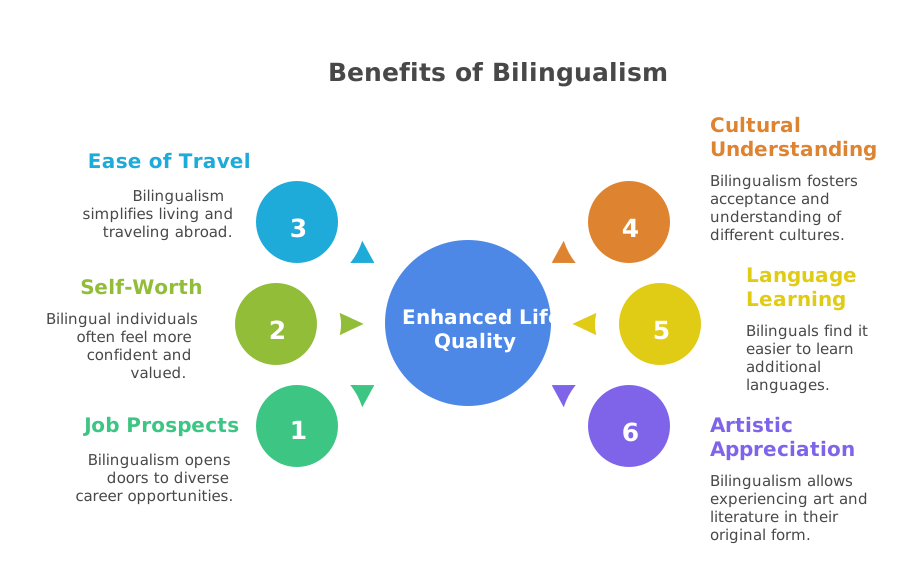
A wider variety of job prospects, with a significant increase in earning power
The ability to learn other languages later on in life with less effort
The chance to experience art and literature in the original language
Tips for bringing up bilingual children
As more people become knowledgeable about the perks of being bilingual, more resources are made available. From books to blogs, there is no shortage of information out there.
We’ve compiled a brief list of some ideas that will help you in your journey to raising bilingual children:
You and your partner may have the same native language, but you can still teach your children your second language, even if you don’t speak it perfectly.
Provide your children with multiple ways to access the second language, whether it’s TV shows, picture books, video games, or audiobooks. Every little helps.
Try not to compare your child’s verbal skills with monolingual children; all children develop at different rates, but it is quite common for bilingual kids to start talking slightly later than their monolingual peers.
Research different methods for bringing up multilingual children, such as One Person One Language, Mixed Language Policy, or Minority Language at Home, and be realistic about what will work for your family.
Find out if there are any local facilities in your area such as playgroups, story time events, or social clubs that focus on the relevant languages.
If it’s a financial possibility for your family, inspire your kids with trips abroad where they can try out their linguistic skills ‘in the real world’.
It’s never too late to start!
Although easier as a child, it’s never too late to learn a new language, and the motivation you feel as an adult will aid you in picking up a new language.
From the traditional classroom and online classes to language acquisition apps and opportunities to work abroad, there are so many ways for you to embrace a new language and culture. It’s not just for kids.