You’ve just graduated with an interpreting degree, and you’re now ready to apply to different companies and organisations for a full-time job, with just an interview standing in your way before beginning your professional career.
You have thought through everything about this next step, and the interpreting world is no longer a step into the unknown for you.
You may have even bought yourself a brand-new notepad for your future note-taking.
Let’s take a look at that in more detail. Here is a short summary of the most important hints and tips to keep in mind as you start your note-taking career. Let’s get straight into it.
Interpreting: a renowned profession full of twists and turns
When you think about it, what better job is there than an interpreter? Bringing people of different languages and cultures together.
Helping people communicate through a language barrier.
And most of all, communicating the messages and knowledge of one person or group to another. These among many others are the main motivations for interpreters to throw themselves into their profession.
From dentists’ conventions in Warsaw, to presentations at film festivals or even translating official UN speeches, the range of possibilities for an interpreter is vast.
It is said that it is impossible for an interpreter to be bored, as they are continually looking for new sectors to explore.
This is why there are so many aspiring candidates trying to make it in the interpreting world, but not everyone can be in Nicole Kidman’s shoes.
It’s an expensive and competitive sector where demand is high, so patience is key.
Consecutive interpretation: a linguistic procedure which is incredibly complex
If you are a regular reader of our posts, you will know that there are several types of interpretation.
Simultaneous interpretation: As its name suggests, it is translating the speech of a speaker into the target language at the same time as they are speaking. This type of interpretation requires the use of state-of-the-art equipment: sound-proof booth, high-performance headsets, top quality microphones, excellent sound diffusion space, headphones, etc.
Consecutive interpretation: In this case, the speaker says a sentence or idea before the interpreter translates everything that was said. Well, not exactly everything. The idea of this type of interpretation is to take notes efficiently to be able to capture the main ideas of what was said. This is where it gets the reputation for being a highly complex job. Consecutive interpretation not only requires excellent linguistic skills, but also a strong ability to listen, take notes, summarise and concentrate.
The importance of taking notes in consecutive interpretation
As you now know, it is vitally important that interpreters are experts at note-taking if they are to accurately convey the key points of a speech.
Our specialists here at BeTranslated have come up with seven key tips for effective note-taking:
Do not write full sentences. Only useful and relevant words are needed
Note down the structure of what is being said as you go along (titles, subtitles, etc.)
Write down the more complex things that can be tricky to remember (numbers, percentages, etc.)
Use abbreviations for words that come up a lot, as this saves a lot of time
Do not go into secretary mode and start writing down absolutely everything
Ensure your notes are clear, making them as easy as possible to read
Use a note-taking application like Bear, Evernote or Notion
If you’re looking for an introduction to Western European languages, this article is a great beginner’s read.
Within Europe, hundreds of languages exist, some of which are widely spoken worldwide.
In this article, we’ve created a brief overview of Western European languages and their history and prevalence within Europe and worldwide.
Let’s take a closer look at this fascinating language group.
Europe’s Languages
Within Europe, there are only 24 official languages, despite there being hundreds of additional languages actually spoken.
That number, of course, is low compared to other continents where sometimes thousands of languages are spoken.
However, the languages of Europe are incredibly diverse and influential, many with very interesting roots.
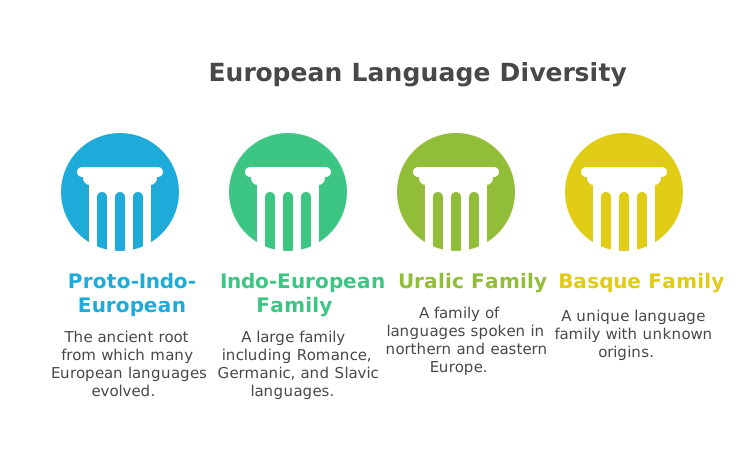
Looking back, the majority of European languages that continue to exist today came from Proto-Indo-European, which is the language that the Indo-European language family came from.
The Indo-European language family is large, containing the Romance, Germanic, Armenian, Celtic, Hellenic, Slavic and Baltic languages.
The area from which these languages originated is the subject of much debate.
In addition to Indo-European, Uralic, and Basque language families exist in Europe and within those families are the majority of European languages.
Romance Languages
Romance languages include a wide range of different languages, such as Catalan, Romanian, Spanish, Portuguese, French, and Italian.
is part of the Germanic group of European languages and has 1.35 billion speakers worldwide, including those who speak it as a first or second language fluently.
Germanic also includes languages such as Norwegian, Swedish, Bavarian, Dutch, and Afrikaans.
Slavic
The Slavic group of languages includes Slovak, Polish, Russian, Czech, and Bulgarian, to name a few. Multiple Slavic languages are spoken worldwide, especially Russian, which has over 250 million speakers across the globe.
Baltic
Baltic languages include Lithuanian and Latvian (Lettish), as well as multiple ancient extinct languages, including Prussian, Selenian, and Selonion.
Celtic
Celtic languages include Cornish, Gaelic, Breton, and Welsh. They are incredibly old languages that come from one Brittonic language that existed in the Iron Age.
Despite these languages being so old, some are still used commonly today, including Welsh, which is still spoken by nearly 30% of the population of Wales.
Hellenic
Hellenic includes Greek, the only language of this group within the Indo-European group of languages.
Albanian
Albanian is alone in its group within the Indo-European group of languages.
Armenian
Armenian is spoken by a high proportion of people living in Armenia, as well as people who live in Russia and Iran.
It’s also important to acknowledge the two other language groups of Europe – Basque and Uralic. Uralic includes Finnic languages and Urgic languages, whilst Basque is a language in its own right spoken in specific areas, such as Northern Spain.
Western European Languages
Western European languages contain a wide variety of languages which are mostly Romance languages from South Western and Central Europe and Germanic languages from Northern Europe, the British Isles and Central Europe.
Various languages are classified as Western European languages, including:
Irish
Scots
Gaelic
Manx
Welsh
Breton
Greek
Cornish
Finnish
Hungarian
Maltese
Basque
French
Portuguese
Italian
Spanish
Dutch
Some of the most commonly spoken Western European languages are Spanish, Italian, French, Dutch and Portuguese.
These are the languages you may have considered learning if you want to travel around Western Europe, and you may have studied one or more of them at school.
Let’s take a closer look at these common Western European languages:
Spanish
There are around 460 million native Spanish speakers worldwide. Aside from Spain itself, America has the highest population of Spanish speakers in the world.
The language has been around for over 1,500 years and has its origins in Latin.
Unlike Classical Latin which we still see in the written word, the Spanish we see today is called Castilian Spanish.
This type of Spanish has an authoritative source called the Royal Spanish Academy, which was founded in 1713 to standardise this type of Spanish, produce reference dictionaries and keep official Spanish language dictionaries updated.
has around 67 million native speakers, and it is spoken in Italy, Switzerland, San Marino and Vatican City.
The Italian language comes from Latin and developed over a long period of time following the Roman Empire falling in the 5th century.
While there are Italian documents dating as far back as 960 CE, the first real evidence appeared at the beginning of the 13th century.
Many poems and pieces of writing appeared during this time.
Modern Italian is formed from the Tuscan dialect, although multiple other influences exist and contributed to the Italian we know today.
French
Around 88% of the population of France speak French as their native language. French is also widely spoken across many countries, including 29 with it as their official language.
The French language we know today has origins in a part of Western Europe that no longer exists, called Gaul.
The language of that region has little impact on the actual French language we speak today, but over 100 words from that language went into the Latin language; those words then came into the French language and 70 are still used today.
More complex historical events have influenced the development of French, but its Latin roots are the reason many English speakers feel that it is easier to learn French than other languages.
The same could be said for other Romance languages, which all descend from Latin.
Dutch
There are over 23 million speakers of Dutch worldwide.
It is also spoken in various other countries, including Aruba, Curaçao and St Maarten, where it is an official language.
The Dutch language spoken today was part of Old Franconian during medieval times.
Old Dutch then started to develop and branch off from Old Franconian, eventually becoming the main language in areas of Europe that we now know as Northern Belgium and the Southern Netherlands.
Old Dutch eventually turned into Middle Dutch, which then changed into various different dialects.
It was in the 17th Century that the language was standardised by Protestant authority figures within the Dutch Republic as they created a Dutch edition of the Bible.
Portuguese
Portuguese is spoken by over 275 million people in the world, with most speakers of the language in Brazil.
The language started on the Western Iberian Peninsula as Latin, which was introduced when Romans took over the area.
Once the Roman Empire collapsed, Germanic communities took over the area, and Latin developed into Galician-Portuguese because that part of the world was known as Galicia at the time.
Once Galicia was merged with Spain, Galician and Portuguese became two separate language branches, and Portuguese then developed into the language we know today.
Speak to a professional
If you’re looking to learn more about Western European languages as part of a business expansion, then consult an expert.
As we’ve outlined above, there are so many languages and variations within the broad spectrum of European languages.
Therefore, if you’re looking to put together new marketing materials, you’ll need to make sure your videos and voice-overs are accurate and relevant to your target audience.
Otherwise, have fun exploring and learning more about the rich culture and history of European languages.
Don’t hesitate to contact BeTranslated for any professional language services that you may require for your business or your personal needs.
If you want your business to be more focused towards an international client base, translating your retail site could be just what you need.
However, using an untrained translator or getting bad advice can mean you will not achieve your plans of being able to connect with them.
Online retail has its own rules and quirks and to produce a good translation, the translator you hire must understand them and take them into consideration.
Online codes of retail
Online retail differs in many ways from its more traditional cousin, the old-fashioned storefront.
The customer processes are clearly not the same and the reasons providing them to make purchases are not the same either.
Presentation of a product in a traditional shop, its packaging and availability, as well the attitude and efficiency of the sales assistant, play a key role in a customer’s buying experience in this sector.
There are any number of e-commerce sites where buyers can order practically anything, from clothes, to furniture, to cosmetics to toys, or even food and tools for DIY or building things.
All of these things are just a click away.
As surprising as that might seem, it is also possible to buy wood or fabric on these sites!
On a retail site, a number of other aspects should be taken into account, such as product photos, descriptions, directions for use, reviews from previous customers, and shipping fees to be paid.
It is therefore key to be more rigorous than in-store retail if you expect your brand to make a mark on the internet and within the digital industry.
Retail translation is the key to success for your retail site
If your retail site has been successful in your company, you probably dream of going global with it and, therefore, making it multilingual. Expanding into strong online markets such as the French e-commerce, German e-commerce or the Korean e-commerce industry requires adapting not only the language but also the visuals, the tone and the user experience to local expectations.
To provide this, you can enlist a professional translation service that specialises in website localisation. If your site is already multilingual, you will surely know how vital communication through good-quality translation is in the market.
As we noted earlier, text accompanying product photos is a determining factor in making a purchase, offering the client an idea of a product even though it is not in front of them and to realise why this product is necessary to them and why they should buy it.
To enhance your product images and engage customers effectively, consider using a photo editing app.
If you unfortunately use the services of a poor-quality translator, they will have limited knowledge of how to communicate your brand’s spirit while adapting the content to the requirements of the target companies.
On the other hand, if you use a qualified translator who is an expert in retail, they will know how to reach your consumers and, consequently, how to help you set yourself up in another part of the world.
The advantage of good retail translation services for your retail site
There are many advantages of a successful translation for your site:
If your page is in another language, it will be more relevant and will resemble, as much as possible, the one you built in your mother tongue.
Your brand or company’s buzzwords will be faithfully respected; the spirit that you want to give your brand will be maintained and adapted to the best of the professional’s ability.
Your site will be adapted to the target audience and, if necessary, changes will be made to your original text to ensure that it meets the specific expectations of your international client base and doesn’t shock or offend them with certain terminology, slogans, product names or colours. What is acceptable in one country can differ greatly in another. For example, while white represents purity for Europeans, in Arab countries it is the colour of grief.
Your international clients will therefore have a pleasant, user-friendly experience and probably won’t even realise that they are using a translated page, helping them to buy your products more easily.
How do I know if the retail translation services used for my retail site are working?
There are several ways of checking whether the retail translation services that you ordered have been carried out, bearing in mind the criteria provided above.
If sales are not taking off in the countries targeted by your translation, that might indicate that your site hasn’t been translated thoroughly.
For example, maybe your product names haven’t been changed even though they should have been, or even that the description of your products and services hasn’t been appropriately written.
If you have any questions, contact us at global@betranslated.co.uk or call us at +442030269848. If you would like to request a free, no-obligation quote, get in touch today.
Trademarks are significant intangible assets in today’s culture.
A well-known mark is a substantial source of income for a company.
In addition, a brand serves as a visual representation of the company and its products.
As a result of the intense market rivalry, these marks play a crucial role in concentrating products on the market.
To be successful in market competitions, all companies have a similar value system.
As a result, translating marks for different regions is highly significant and can have a substantial impact on a business.
If you want to expand your business abroad, here are the ways in which translating brand names can benefit your organisation:
Translations can take you to a global market
A product’s brand name is critical. However, having a solid name alone isn’t sufficient. It’s vital to have an accurate and professional translation.
Similarly, if you have invented a new product, you may wish to look into securing a patent for your innovation, as this patent will provide you with more protection, ensuring your company is secure for up to 20 years.
As a result of entering the World Trade Organization, China has seen an influx of international goods.
Nevertheless, a well-translated mark is unquestionably an effective marketing tool and symbol for a company.
It may also assist a business, allowing it to reach a broader global audience, and it can take you to a worldwide market.
Translations must conform to local customs
The target audience’s customs should be followed while translating brand names.
Chinese brand names, for example, are often composed of two or three phrases, aligned with Chinese tradition.
Traditional Chinese names and names of places are written and are comprised of two or three words at most.
This approach should be followed when localising brand names from English into Chinese.
Once you join the Chinese market, the vast majority of your client base will be from China itself.
However, because these names come from many cultural backgrounds, they must first be translated into Chinese.
They may gain market share and the trust of Chinese consumers if they have a competent translator on their side.
As a result of cultural differences, individuals have various ways of thinking, temperaments, and interests when it comes to art and design.
Therefore, the specific cultures of the target nations should be reflected in the translation.
Translations must comply with local laws
Translations of brand names must adhere to local rules and regulations, particularly intellectual property laws.
This is because legislation varies from country to country, so you must be extra careful while translating.
For example, the word ‘citizen’ was rendered as ‘希奇准’ throughout the city. These three Chinese characters accurately and concisely define the product.
However, because of Hong Kong’s legal requirements, the brand name was rejected during the registration process. As a result, ‘Citizen’ was later retranslated as ‘西铁城.’
Translations protect intellectual property
In order to differentiate one company’s products or services from those of another equivalent business on the market, brand names are used.
Intellectual property rights protect these names.
A name may be registered for national or regional legal protection at the appropriate office by submitting an application for registration and paying the necessary fees.
However, translating intellectual property isn’t easy. Since it involves so many nuances and linguistic subtleties, it requires an expert’s touch.
As there is a lot of complexity and subtleties involved in translating intellectual property, it’s best left to those with extensive experience.
Translations bring huge profit
A well-translated brand name is unquestionably an effective marketing tool for a company. It may also assist a business in reaching a broader global market.
A solid brand seems to play a crucial role in conveying meanings, explaining the benefits of a product, and differentiating it from competitors.
A good name may save a company a lot of money, while simultaneously generating enormous revenues.
As a result, businesses make no compromises when exploring the commercial attractiveness of brand names from every angle.
Conclusion
To summarise, brand names are critical to the sale of goods.
Cultural and religious differences may have a significant role in the translation, so it would help if you prioritised these aspects while working on it.
As a successful UK company, you will naturally be looking to expand and make inroads in other markets, maybe ones that do not speak English.
Translation is, therefore, the next logical step, but the big question is, how much does it cost to translate a document?
There is no single answer to this as it will vary according to the industry, of course, but the good news is that are always high-quality translation services to meet your business’s budget.
Here are the things to consider.
Factors in the cost to translate a document
Factors affecting the cost to translate a document include:
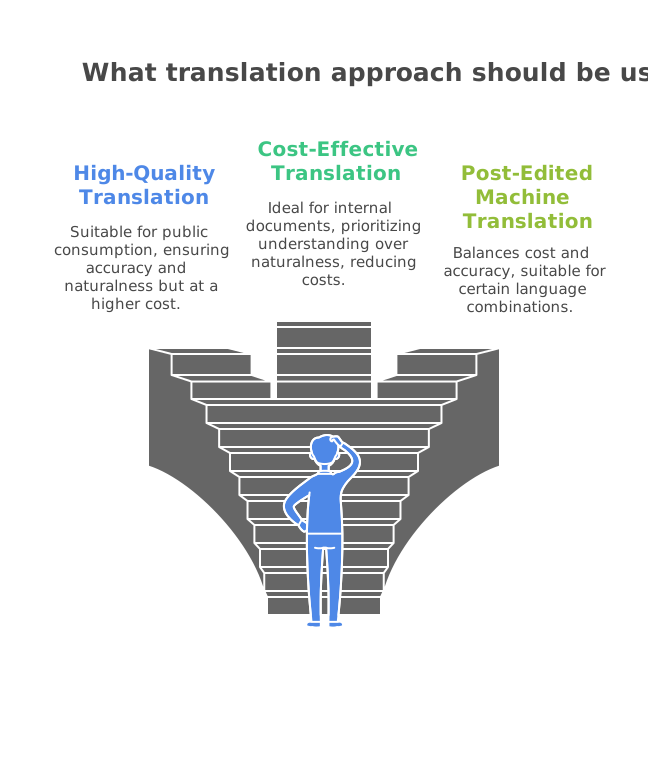
Documents for public consumption should be very high quality, and the higher cost will include additional editing.
Internal documents, where understanding is more important than sounding perfectly natural, can be more cost-effective as they require less rigorous checking.
Here, a human translator revises and edits machine translations for texts that are accurate and at a lower price.
Some language combinations are more suited to this than others, but it works very well for Western European languages.
Language combination
You will probably be wondering by now what the cost to translate a document into several languages at once is.
This also can vary, as some language combinations are cheaper than others. For instance, translation into Finnish costs more than into Spanish as, typically, there are more translators working into Spanish.
Translation services are generally priced based on the number of words in the source text.
There can be discounts for repetitions within a text or matches from a previous translation.
BeTranslated can give a breakdown with your quote on request. You can also expect volume discounts for large projects.
If you are on a tighter budget, a better investment is to batch-translate to minimise costs over time.
How long does a translation take?
For quick translations, you can expect to pay more. But bear in mind that while quick translations can be convenient, quality and consistency could be affected.
A fast turnaround is more logistically demanding, so it pays to plan ahead and leave plenty of time for a translation that meets your exacting standards.
We can customise the turnaround time in some situations, so please get in touch for more details. In addition, our network of freelance translators is worldwide, meaning one of our BeTranslated translators can meet your deadline, whatever the time zone.
Technical level
The more technical a document, for example, legal or medical texts, the higher the price point.
Here at BeTranslated, we understand that technical translations can be quite specific to the situation, so we work with our linguists to find the right terminology and involve experts from your company in the final word choice.
You can also provide a glossary to ensure consistency across texts.
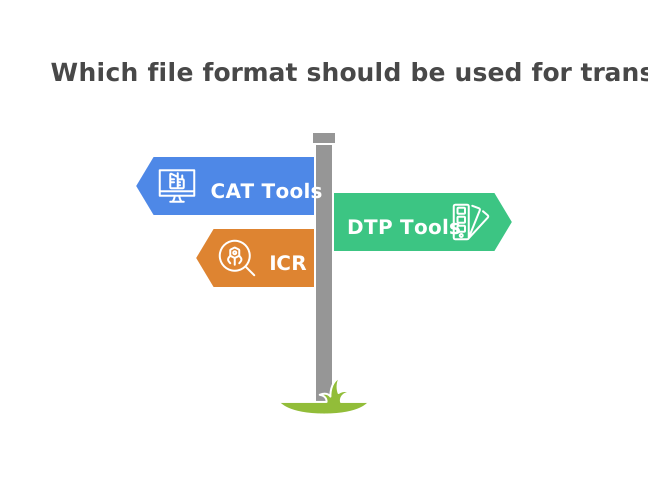
What file formats can be translated?
CAT tools: Work with Word or Excel files; other file types must be converted, adding extra time and cost.
DTP tools: InDesign and Illustrator require layout editing after language changes, which BeTranslated offers at an additional cost.
ICR (in-context review): Available for translated website content, billed by the hour
How often do you need translations?
If you have frequent needs, BeTranslated can offer you some discounts and assistance with creating a translation memory (TM).
This is a tool that can help for regular projects as it is a database of your previous translations, so you can use the same vocabulary to ensure consistency and reduce costs.
It is particularly useful for content like product catalogues.