The word ‘immigration’ can have negative connotations for some, but there are many positives that don’t make the news.
Despite Brexit and a global pandemic, immigration solicitors for individuals continue to see the UK as an incredibly popular destination for immigrants from Europe and beyond.
Last year, almost 1 million people immigrated to the United Kingdom from Europe and beyond.
While living and working in the UK has become more restrictive since Great Britain’s departure from the EU in 2020, it’s far from impossible.
Today, a number of different visa options offer immigrants the opportunity to relocate to the UK for a period of time, and some include:
Seasonal Worker visa (Temporary Work)
Government Authorised Exchange visa (Temporary Work)
Creative Worker visa (Temporary Work)
Religious Worker visa (Temporary Work)
Charity Worker visa (Temporary Work)
International Agreement visa (Temporary Work)
While most of these visas are based on a limited time, some can be renewed or extended for a longer stay.
How Can Immigration Drive Business Growth and Innovation?
There are a few ways in which immigration can drive business growth and innovation, and we’ll be examining some of these in this section:
Plugging the skills shortage gap
Despite being home to some of the world’s best colleges and universities, UK businesses often struggle to source skilled and experienced staff in some sectors such as technology.
By being able to source employees from overseas, UK companies are able to plug their skills gaps and remain competitive with the rest of the world.
Connecting cultures
As technology makes international business easier than ever before, UK businesses understand the value of employees who are able to speak two or more languages.
Throughout Europe, English is taught and spoken widely, meaning that employees are able to hit the ground running after moving to the UK, as well as adding the very real benefit of a second or even third language.
In addition, an immigrant employee will often have an understanding of a particular culture, which may not be the case with UK staff.
This can help to forge deeper and more effective business relationships with overseas businesses.
A melting pot of ideas
Hiring immigrant employees is a great way of increasing diversity in your workplace.
The knock-on effect of this is that when you have a workplace made up of different people from different backgrounds and cultures, you introduce a melting pot of ideas and ways of working.
This can be particularly effective for companies operating in creative industries, where competition tends to be fierce.
Money matters
When hiring staff with specialist skills, UK companies will usually be looking at graduates who, even at junior levels, can be expensive.
On the other hand, hiring skilled employees from rapidly emerging markets such as Poland and Slovenia can be extremely cost-effective.
This is not to say that employees from such countries are valued less, but salaries may generally be lower abroad, so they are able to accept lower salaries and still live comfortably.
Tapping into the upskill
When you have a diverse workforce, you automatically encourage knowledge sharing.
For UK businesses, this can introduce an opportunity for upskilling existing employees, as immigrant staff share their unique knowledge and skills within the workplace.
In normal circumstances, upskilling employees can be an expensive business.
So, as well as adding a level of diversity, immigrant employees can help to keep down upskilling costs within a business.
Bringing the world closer
Advanced technology means that more and more employees are able to work remotely.
This presents significant opportunities for UK businesses and for immigrants, as immigrant employees are able to live and work in Great Britain, but also visit their home country on a regular basis without a break in their productivity.
Getting onboard with immigrant employees
As we’ve highlighted in this article, there are some excellent reasons for employing immigrant workers, however, there are some strict rules involved.
Before committing to an employment contract, make sure that you are aware of the regulations as well as seeking evidence that the employee has the right to work in the UK by, for example, holding the correct visa.
If you’re unsure of your obligations as an employer when hiring immigrant staff, the Government website will help to steer you onto the right path.
A new way for the UK
In today’s world, our working lives are evolving rapidly – as are businesses.
The digital world offers a huge number of opportunities, and, as great as this is, it also means a higher level of competition than ever before.
Being able to source employees from overseas is a fantastic way of gaining an advantage if your business has a lot of competition, as well as adding new ideas and innovation to your operation.
As mentioned in this article, you do, however, need to make sure that you have followed all the British Government’s regulations when hiring immigrant workers in order to avoid a hefty fine and/or potentially losing your employee.
Please be advised that this article is for general informational purposes only, and should not be used as a substitute for advice from a trained legal professional.
Be sure to consult a legal professional if you’re seeking advice about business immigration.
We are not liable for risks or issues associated with using or acting upon the information on this site.
In this article, we’ll be providing actionable tips for businesses looking to sponsor overseas workers…
In today’s globalized world, businesses often require international talent to thrive and grow.
The United Kingdom offers a robust points-based system for British citizenship that allows businesses to sponsor foreign nationals, enabling them to work and contribute to the UK economy.
This comprehensive guide aims to provide businesses with an in-depth understanding of the UK visa sponsorship process.
From the fundamental principles of the points-based system to the intricacies of sponsorship license applications, sponsor responsibilities, and the renewal and extension process, this guide will equip businesses with the knowledge and tools necessary to navigate the complexities of UK visa sponsorship.
Overview of the Points-Based System
The UK’s points-based system serves as the foundation for immigration control and assesses an individual’s eligibility to work or study in the country.
It consists of several tiers, each catering to different categories of migrants.
Understanding the tiers within the points-based system is essential for businesses seeking to sponsor foreign workers.
The main routes for skilled workers include the Skilled Worker route, the Intra-Company Transfer route, and the Global Talent route.
Each route has specific requirements, and businesses must align their sponsorship strategy with the appropriate visa route to bring foreign talent onboard successfully.
Sponsoring License Application Process
To sponsor foreign workers, businesses must obtain a sponsorship license from the Home Office.
The sponsorship license application process involves thorough preparation and the submission of detailed documentation.
Businesses must demonstrate their legitimacy, provide evidence of their ability to meet sponsorship obligations, and establish the genuineness of their need for sponsored workers.
Engaging with immigration specialists or solicitors experienced in sponsorship license applications can significantly enhance the chances of a successful outcome.
They can guide businesses through the application process, ensure all necessary documents are included, and help meet the Home Office’s requirements.
Roles and Responsibilities of a Sponsor
Once granted a sponsorship license, businesses become responsible for fulfilling specific duties as sponsors.
It is crucial to understand these responsibilities to maintain compliance with immigration laws and ensure the well-being of sponsored employees.
Sponsors must have systems in place to monitor and record sponsored employees’ attendance, report any changes in their circumstances to the Home Office, and maintain accurate records throughout the sponsorship period.
They also play a vital role in guiding and supporting sponsored employees through the complexities of the UK immigration system, ensuring they understand their rights and obligations.
Considerations for Sponsorship Renewals and Extensions
Sponsorship licenses have a predetermined validity period, typically ranging from one to four years. It is essential for sponsors to initiate the renewal process well in advance of the license expiry date to maintain continuity in sponsoring foreign workers.
During the renewal process, sponsors must provide updated information about the business, demonstrate ongoing compliance with immigration requirements, and ensure that all relevant documents are up-to-date.
Failure to renew the sponsorship license on time may result in the inability to continue sponsoring foreign workers.
In addition to sponsorship license renewals, sponsors may encounter situations where individual employees require visa extensions to continue working for the sponsoring business.
Managing these extensions involves careful coordination, timely application submission, and adherence to the Home Office’s guidelines.
Sponsors must monitor visa expiration dates and initiate extension applications with sufficient time to avoid disruptions in employment.
Seeking guidance from immigration professionals can help sponsors navigate the renewal and extension process efficiently.
Compliance and Reporting Obligations
As sponsors, businesses have a duty to comply with ongoing reporting requirements set by the Home Office.
This includes reporting any significant changes in the employment status of sponsored workers, such as termination or changes in working hours or job roles.
Sponsors must also notify the Home Office of any relevant changes within their organisation, such as a change in ownership or structure.
Failure to comply with reporting obligations can lead to sanctions or the revocation of the sponsorship license.
Therefore, sponsors must establish robust systems to monitor and fulfil their reporting duties diligently.
Hiring Overseas Workers
Navigating the UK visa sponsorship process is a complex undertaking for businesses.
Understanding the points-based system, completing a successful sponsorship license application, fulfilling sponsor responsibilities, and managing renewals and extensions require meticulous planning and adherence to immigration regulations.
By investing time and resources in comprehending the intricacies of the process and seeking expert advice when needed, businesses can effectively navigate the UK visa sponsorship landscape and harness the benefits of hiring international talent.
Please be advised that this article is for general informational purposes only, and should not be used as a substitute for advice from a trained legal professional.
Be sure to consult an immigration lawyer/solicitor if you’re seeking advice on sponsoring an overseas worker. We are not liable for risks or issues associated with using or acting upon the information on this site.
In a global business world, the financial sector is increasingly turning towards premium financial translation, so that international stakeholders remain up to speed with their investment’s performance.
Developing a close relationship with a specialist translator is crucial for those in the financial industry, and especially for businesses operating in English and French speaking countries.
Firstly, as a technical field, the finance sector has a lot of its own specific terminology and complex ideas which specialists understand easily, but can seem very daunting to outsiders.
In addition, cultural and regulatory idiosyncrasies play a big role and should be kept in mind when translating from English to French.
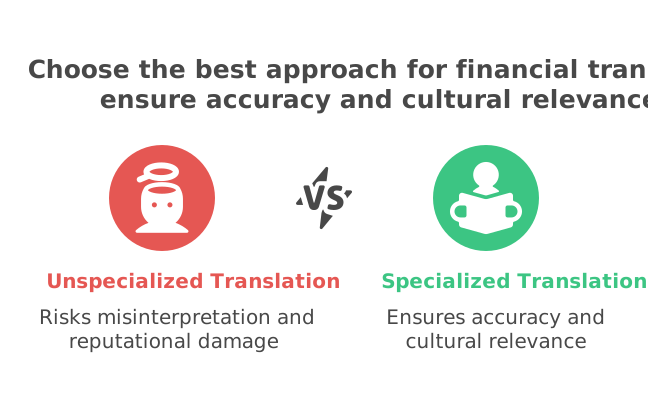
Financial translations that aren’t carried out by professionals, might allow the reader to get the gist of your message, but they will not precisely convey its originally intended meaning.
Poor communication can have a negative effect on your future viability, risking loss of trust from stakeholders, and meaning your potential failure to meet your client’s expectations.
Industry knowledge is key in financial translation
As you review your yearly balance sheet, you may wonder who else might be able to distinguish between accruals and realised profits or understand why prepayments are classified as liabilities.
Most people would agree that translating a document which seems completely unfamiliar is incredibly daunting, and there is potential for it to go very wrong.
Within financial translation an anectode has drew attention: an accountancy firm which had decided to delegate their balance sheet translation to an unspecialised translator, was surprised to notice that “stock” had been wrongly translated into “shares” in French, as opposed to “inventories”.
A mistake like this, which can damage a company’s reputation, could have been easily avoided if the translator had undertaken rigorous training, whether academic or professional, in the financial sector.
A professional French-to-English translator must also be aware of the guidelines regarding formatting, numbering, and terms in both countries.
The reason this matters is that certain English technical concepts have no French counterpart, such as EBITDA (earnings before interest, taxes, depreciation and amortisation).
Consequently, a professional translator must undertake a contextual analysis, in order to find the French equivalent; in this case, it could be BAIIA or EBT.
Also, from an editorial perspective, certain financial documents, such as investor reports, tend to obey different modes of expression, as they cater to readerships with different expectations of the document.
To address all the above risks, ideally, you should rely on a professional translator who has had experience working and/or studying in both a French and an English-speaking country.
Essential financial documents handled in financial translation
Key investor information documents (KIID)
Investment fund reports
Investor reports
Balance sheets
Income statements
Financial reporting guidelines
Bank documents
Information memorandums
Investigation papers
Risk management and asset management documents
Audit reports
One thing that these documents have in common is that they carry considerable weight in terms of the amount of information they contain and the business stakes they involve.
It is crucial to treat the translation of these documents with great caution because of the potential repercussions.
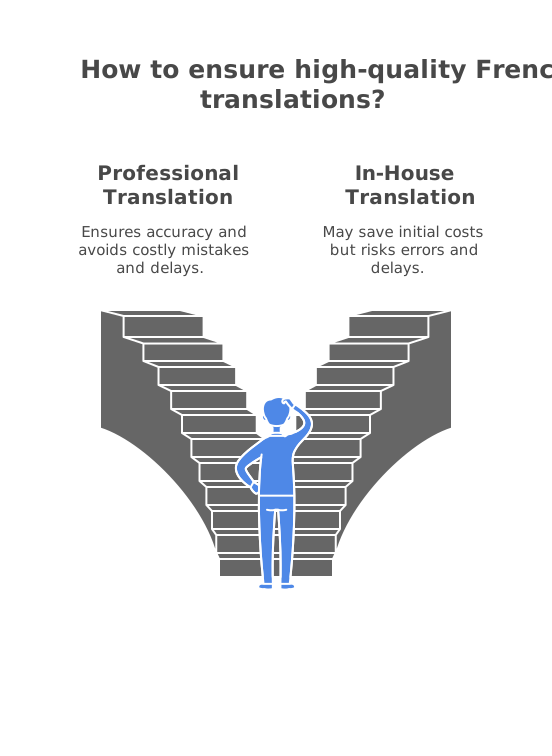
Low-quality French translations often result in an increase in the total costs of your operations, as you inevitably need to call upon a professional to clear up any mistakes.
Additionally, severe delays may occur if your financial presentations (or memos) fail to accurately convey the terms and conditions of your projects.
Finally, your company may suffer loss of reputation in French-speaking countries or incur lawsuits from your proposals being rejected by the local regulatory bodies.
It is important for your translation partner to measure these risks appropriately.
Often, specialist translatorshandle these challenges with the tools they use, which are able to manage terminology accuracy, and will include post-translation checks and proofreading in their services.
Find the perfect agency, build a long-term relationship
Building a long-term relationship with your financial translator ensures that your firm’s idiosyncrasies are well known, therefore limiting the possibility of your identity as a business being misrepresented.
The longer you work alongside a translation provider, the higher the quality of your documents will ultimately become, whether in French, German, or any other language.
To determine whether your partner is suitable, consider their degree of financial specialisation, shown by the qualifications or experience of the financial sector translators.
Also, make sure that your provider has a robust terminological base and can adapt to your preferences if need be.
Finally, make sure that communication between your firm and your provider is clear and honest to avoid costly mistakes and ensure your stakeholders ultimately remain perfectly informed; this will only benefit your business in the long run.
Navigating the job market can be like walking through a maze, especially when you’re trying to enter a specialised field like translation.
But don’t fret; it’s far from impossible.
You’ve got skills, you’ve got passion, and after reading this article, you’ll have the roadmap you need to land your dream job in the translation industry.
Know Your Strengths and Weaknesses
Before diving head-first into job applications, take a step back and evaluate your own skill set.
What languages do you speak fluently? Are there any specific industries you’re particularly knowledgeable about—like law, medicine, or technology?
Having a clear understanding of your strengths and weaknesses will not only help you target the right job opportunities but also give you a competitive edge when customising your CV and cover letters.
Speaking of which, crafting an impeccable CV is crucial.
Crafting a Winning CV
In the UK job market, your CV is more than just a piece of paper; it’s your professional passport. It’s what gets your foot in the door and sets the stage for an interview.
If you’re not familiar with the CV format common in the UK, take some time to research and adapt your existing CV to it.
There are numerous templates available online to get you started, but for those wanting a bit more flair, Adobe Express offers a range of creative yet professional CV templates you can utilise.
They also have a range of design tools that you can use to craft your CV from scratch.
Beyond format, focus on the content.
Highlight your language proficiencies, relevant work experiences, and any translation-specific certifications you might hold.
Remember, it’s not just about showcasing your skills but also demonstrating how you can add value to a potential employer.
Get Certified, Get Ahead
While not a strict requirement for all translation jobs, getting certified can significantly boost your chances.
In the UK, you can consider accreditations like the Diploma in Translation (DipTrans) from the Chartered Institute of Linguists or membership with the Institute of Translation and Interpreting.
These credentials not only validate your skills but also make you more appealing to employers, who see value in certified professionals.
Certification programs often include both theory and practical exams, covering various translation techniques and subject matter expertise.
By successfully completing these, you’re essentially demonstrating your readiness to tackle professional assignments.
Freelance vs In-House
At some point, you’ll need to decide between freelancing and working in-house. Both have their merits and drawbacks.
Freelancing offers flexibility and the freedom to choose projects, but it also means inconsistent income and the hassle of running your own business.
On the other hand, in-house positions offer stability and often come with benefits like healthcare and retirement plans, but you might find yourself stuck with projects that don’t particularly interest you.
Consider your lifestyle, financial situation, and career goals when making this decision. Some people start with freelancing to build a portfolio and then transition to an in-house role, while others find freelancing to be their lifelong calling.
Learn to Network
Many people groan at the thought of networking, associating it with awkward conversations and forced smiles.
However, when done right, networking can be your secret weapon in breaking into the translation industry.
Attend industry-specific events, webinars, or even online forums where you can connect with like-minded professionals.
And don’t just limit yourself to other translators; clients, agencies, and even educational instructors can offer invaluable insights and opportunities.
LinkedIn can be a great platform for networking as well. Engage with content, share your own insights, and don’t hesitate to connect with professionals in the field.
You never know; your next job offer might just be a DM away.
How cultural context shapes meaning, tone, and accuracy across languages
When we need to translate something, most of us reach for Google Translate, assuming it will do the job.
But Google often mistranslates sentences and misses crucial cultural and linguistic nuances.
Cultural sensitivity matters in translation. Here’s what you need to know.
How culture changes word meanings
As Europeans travelled west to conquer the New World, they brought their languages with them. That’s why people in the Americas speak English, French, Spanish, and Portuguese.
However, these languages have diverged considerably over time.
Take French as an example. France remains the centre of the French language, whilst people in Quebec, Canada, have spoken it since Jacques Cartier arrived in 1534.
Almost 500 years later, Canadian French differs markedly from European French in usage and accent. Understanding French culture when learning French is therefore essential.
This can lead to serious misunderstandings when a word carries completely different meanings in each region.
Consider the word “gosse,” which means children in France. In Quebec, the same word refers to male genitalia.
Without understanding this cultural distinction, you could either make people laugh or deeply embarrass them.
What is cultural sensitivity, and why does it matter in translation?
Every society has its own cultural sensitivities. Although these are weakening in an increasingly globalised world, they still exist and must be considered when you translate into another language.
Cultural sensitivity encompasses norms, beliefs, values, customs, and behaviours.
Without understanding these, conveying a message in another language becomes difficult—or worse, creates deep misunderstanding.
Communication style matters too. When interpreting live, you may need to maintain eye contact with one person, whilst the same behaviour would be considered impolite in another culture. Your dress may also cause offence depending on religious beliefs.
A single word can change the meaning of an entire sentence, even if technically correct. The message may come across as offensive when it wasn’t intended to be. And whilst you can claim misinterpretation, words are difficult to take back once spoken—or worse, written.
Demonstrating cultural awareness generates respect. In business, such attention to detail can forge strong trading relationships that last for years.
How to ensure cultural sensitivity in your translations
A translator’s learning never stops. Working with more experienced professionals helps build cultural knowledge for the specific countries where you operate.
Do your research
Research should always be your first step when working in a new country. There are countless ways to learn about cultures today, starting online. Speaking with local people is particularly valuable for understanding what you can and cannot say.
Watch for local dialects
In some countries, dialects play a significant role in communication. Italy is a prime example, where each region—sometimes each city—uses a different dialect. A translator must account for this.
Anyone working in translation needs to understand cultural sensitivities to convey meaning accurately. That’s why it’s better to specialise in a few countries rather than spread yourself too thin.