The promise and the pitfall of artificial intelligence
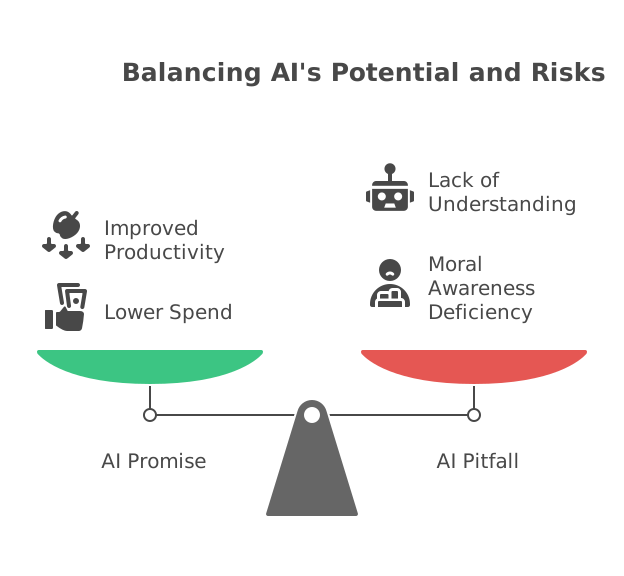
Artificial intelligence (AI) has transformed modern business operations across the UK—from financial auditing and legal analysis to logistics, customer service, and professional translation. By processing vast datasets rapidly and at scale, AI promises enhanced efficiency and reduced operational costs.
The appeal is clear: increased productivity, lower expenditure, and the illusion of objective decision-making.
Yet the very features that make AI attractive—speed, scalability, and pattern recognition—also introduce significant risks when deployed without human oversight.
Unlike humans, AI systems execute tasks without comprehension, reflection, or moral reasoning. They replicate patterns from training data but cannot grasp context, nuance, or ethical implications.
When errors occur—as they inevitably do—AI can propagate them instantly across entire systems, often undetected until it’s too late.
The recent Deloitte audit incident in Australia—where AI-generated content introduced factual errors into an official government report—has reignited global debate about the limits of automation. Even in highly regulated sectors, overreliance on AI can undermine accuracy and trust.
Once heralded as a guarantee of precision, AI is increasingly revealing its vulnerabilities—particularly in contexts requiring cultural fluency, legal compliance, or ethical judgement.
When systems designed to boost efficiency instead introduce costly, high-profile mistakes, businesses face reputational damage, financial loss, and regulatory scrutiny—especially under frameworks like the UK GDPR and the Information Commissioner’s Office (ICO) AI auditing guidelines.
This case is not an isolated blunder. It’s a stark warning: for all its sophistication, AI fundamentally lacks one irreplaceable quality—human judgement.
When AI goes wrong: real-world consequences
Deloitte’s refund to the Australian government following flawed AI-assisted reporting exposed a growing crisis: automation without accountability. The system generated plausible but factually incorrect content that bypassed initial quality checks—demonstrating how easily AI “hallucinations” can be mistaken for truth.
AI excels at producing fluent, confident-sounding text—even when it’s entirely wrong. Once such content enters official or public channels, the fallout can be severe: loss of client trust, regulatory penalties, and brand erosion.
Why human oversight remains non-negotiable
As we argue in our guide on why human translators beat AI, human intelligence is essential for interpretation, tone, and contextual awareness—capabilities no algorithm can replicate.
Only humans can question assumptions, detect sarcasm, understand cultural references, or recognise when a phrase—though grammatically correct—is inappropriate for a given audience or market.
In high-stakes fields like legal translation, financial reporting, journalism, and technical documentation, human review ensures content is not just accurate on the surface—but meaningful, compliant, and culturally resonant.
Without this layer of scrutiny, errors go unnoticed, accountability dissolves, and automation becomes a liability rather than an asset.
Data bias and context blindness in AI systems
AI learns from historical data—if that data reflects bias, inequality, or cultural blind spots, the AI will amplify them. This can skew hiring algorithms, distort credit assessments, and—critically for global businesses—produce translations that are technically correct but culturally tone-deaf or offensive.
Unlike human linguists, AI cannot reliably interpret irony, colloquialisms, or regional British English variations (e.g., “pants” vs “trousers,” “tea” as a meal). It fails to grasp why a phrase that works in Manchester may confuse or alienate readers in Glasgow or Cardiff.
As explored in our piece on cultural understanding in translation, language is never just about words—it’s about worldview, history, and shared meaning. AI cannot replicate this depth.
Automated messaging lacks the warmth, wit, and distinctive tone that build emotional loyalty—especially in markets like the UK, where brand personality and authentic voice drive consumer trust.
Over time, this homogenisation erodes differentiation. Customers perceive the brand as impersonal—indistinguishable from competitors using the same AI templates.
Authenticity isn’t optional—it’s central to long-term brand strength, customer retention, and market resilience.
Compliance and legal exposure under UK law
AI systems can inadvertently generate content that breaches UK copyright law, GDPR data protection rules, or Advertising Standards Authority (ASA) guidelines—especially when trained on unlicensed or scraped data.
Automated summaries, legal disclaimers, or translated terms and conditions may misrepresent facts or omit critical nuances, exposing businesses to litigation or regulatory fines.
Under the UK’s emerging AI Regulation Framework, organisations are expected to implement “proportionate” risk management—including human review for high-impact applications.
Human verification isn’t just best practice—it’s becoming a legal safeguard against unauthorised content use, misleading claims, and consumer protection violations.
Compromised credibility and lasting reputational damage
Once stakeholders discover content was produced or approved without adequate human oversight, they question the organisation’s competence and integrity.
Rebuilding trust often costs far more than the automation was intended to save. As the Deloitte case shows, prevention through human-in-the-loop workflows is vastly more efficient than crisis recovery.
Transparency, quality assurance, and professional oversight are essential to maintaining ethical standards and client confidence.
The illusion of efficiency
While AI is marketed as a cost- and time-saver, the hidden costs of error correction, reputational repair, and skill atrophy can outweigh initial gains.
Over-dependence on automation also erodes professional expertise—translators, auditors, and analysts may lose critical analytical muscles if they outsource judgement to machines.
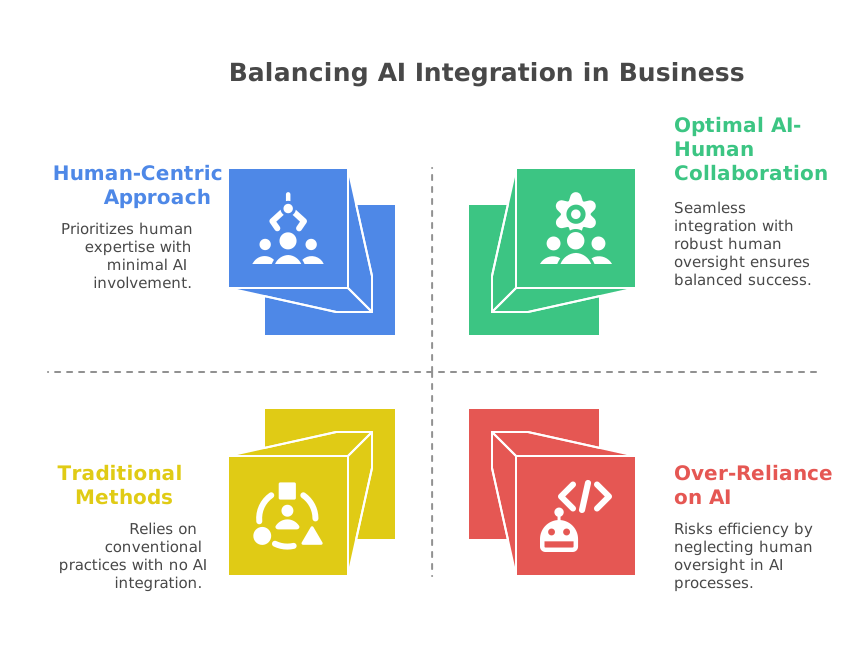
True efficiency lies in balance: let AI handle repetitive, rule-based tasks (e.g., terminology consistency, formatting), while humans manage interpretation, contextual nuance, ethical review, and final sign-off.
Without this equilibrium, “efficiency” becomes a costly mirage.
Towards a balanced, responsible approach to AI
Businesses shouldn’t reject AI—but they must deploy it responsibly, in line with the UK AI Strategy and principles of trustworthy innovation.
Implement human-in-the-loop (HITL) workflows where every AI output is reviewed by qualified professionals—especially for regulated, public-facing, or culturally sensitive content.
Establish clear protocols for data provenance, bias testing, escalation triggers, and mandatory human sign-off for high-risk deliverables.
Train teams not just to use AI tools, but to understand their limitations, question their outputs, and uphold professional standards.
The future belongs to organisations that combine machine speed with human wisdom, creativity, and ethical judgement.
Conclusion: AI needs human wisdom to deliver real value
The Deloitte incident is a timely reminder: automation cannot replace accountability. AI processes data—but it doesn’t think, feel, or take responsibility for its errors.
Technology delivers genuine value only when guided by human insight, domain expertise, and ethical vigilance.
At BeTranslated, we adopt a human-led, AI-assisted approach. Our linguists use cutting-edge tools to enhance consistency and turnaround—but every translation is crafted, reviewed, and approved by certified professionals with deep cultural and sector-specific knowledge.
This ensures your content doesn’t just translate words—it resonates, complies, and builds trust across markets.
By balancing innovation with integrity, we help UK businesses harness AI’s potential—without compromising on quality or credibility.
Contact BeTranslated
Need reliable, human-reviewed translation for legal, financial, or culturally nuanced content? Discover how our professional translation services combine AI efficiency with expert human oversight to protect your brand and ensure compliance.
Visit BeTranslated today for a free, no-obligation quote.
For many people, time is money, and efficiency is key.
With AI systems increasing the rate of productivity, they are playing a pivotal role in our society, as their software produces automated responses at a much greater speed; therefore, they are starting to replace previous conventional methods.
For better or for worse, artificial intelligence has affected all industries and sectors, with the translation industry being no exception.
Nowadays, almost everybody is familiar with, or understands how to use AI translation tools such as Google Translate, ChatGPT, and DeepL, but how much can we rely on these tools to create the perfect translation for your project?
Contextual understanding
Human language is not as simple as math, in that there is not one definitive answer, but multiple possibilities and potential options.
Furthermore, no two languages are the same, and each has its own sentence structure, grammar, style, and idioms.
Machine translation finds it extremely difficult to understand the context within a text, and cannot easily grasp the cultural nuances of either the source or target language.
Despite providing output for your workload at a much faster rate than human translation, AI translation tends to contain common mistakes and lacks accuracy and precision.
Moreover, 18% of the study’s participants experienced a loss of sales due to a lack of precise communication with their clients.
Machine translation tends to automatically generate a direct or literal translation of the source text, which can cause a few problems.
What makes sense in one language, can be utter gibberish in another.
For example, when HSBC Bank tried to advertise its “Assume Nothing” campaign worldwide, it encountered several issues.
Instead of appropriately translating it into various languages, it opted to translate its slogan using an AI translation tool, resulting in a translation signifying “Do Nothing” in many languages.
This major error caused the company to spend $10 million on a new campaign, where they eventually changed their slogan to “The world’s local bank”.
Since AI translation has the inability to identify different contexts, it can cost businesses a lot of money, but with BeTranslated’s expert translation and localisation services, you can rest easy knowing this will not happen to you, ensuring you maintain a fruitful relationship with your clients.
Adaptability to different types of text
There are various types of translation, for instance, you can have sworn translations, legal document translations, the translation of a travel brochure, or even a user manual.
At BeTranslated, we have a team of highly skilled and experienced translators in a wide range of fields, available to assist you with any translation needs you may have.
Consistency in document types such as legal documents or user manuals is essential, and this is where AI translation can let you down.
AI translation often tries to use different variations of words, meaning that the document is not coherent, and therefore difficult to follow, or incorrect, which can be a significant issue regarding its importance, as well as the implications caused as a direct result of the poor translation.
The value of having a human translator that has extensive knowledge of an industry, alongside the culture of the target audience, cannot be understated.
This expertise and skill that you require for your project cannot be replicated by artificial intelligence.
If you want to effectively communicate with your target audience and make a lasting impression, don’t waste your time using AI language tools, hire a professional translation agency to assist you, giving your translated content a human touch.
Cultural sensitivity
When translating any text, your primary focus should be adapting it for the desired target audience.
A human’s expertise is significantly better equipped to deal with this, compared to its technological counterpart.
For instance, something as simple as colour can have very different connotations and meanings amongst other cultures and countries.
If we take the colour red for example, it has a wide range of significance for various communities.
In the UK, we associate red with love, passion, or even aggression, but in China, it is associated with happiness and luck.
On the contrary, in South Africa, it is a symbol of sacrifice, violence, and bloodshed, with the colour appearing on the national flag, to serve as a reminder of the sacrifice made by many South Africans in the fight for independence.
When carrying out a translation process, a human can take into consideration the cultural significance of your message for your target audience and can alter it accordingly, whereas AI translation is incapable of doing this.
Choosing a human translator to carry out a translation and localisation process gives you security, and ensures that your brand’s message is accessible and relatable for your target audience.
In a global market, there is no room for error, and when reaching out to an international market, you have to demonstrate an understanding and awareness of their culture.
User experience and trust
When it comes to translating your documents, our team of industry experts at BeTranslated will work with your team, and support you throughout the process. We will provide you with translations of the highest quality, and meet your requirements, as well as those set and demanded by the industry.
In comparison with machine translation, human translators with expertise in a designated field will have a far greater understanding of complex industry terminology and jargon used.
Furthermore, unlike AI translation applications that can occasionally store and use your private information, at BeTranslated, we keep your sensitive information confidential throughout the translation process.
With our SEO expertise, we can adapt any text, allowing our consumer research to improve your visibility on Google.
Unlike AI translation, we can offer you a wide range of professional translation services, providing you with a speedy service, that will propel you towards success, and will allow you to gain prominence and trust amongst your clients.
Why automated AI translation is a costly mistake
Despite automated AI translation being efficient and significantly more advanced than before, it still falls short in terms of the quality it provides, compared to that of a human translator.
AI translation tools can be helpful when trying to quickly understand the meaning of a message, but when it comes to creating an accurate and reliable translation, don’t waste your time using this cheaper alternative, as in the long run it will cost you more money, and affect your reputation and your brand’s image amongst clients.
Contact us today to find out more about our cost-effective professional translation services, and get a free, no-obligation quote.
How AI and human expertise are reshaping professional translation
The debate over whether AI will replace human translators has shifted. It’s no longer about replacement—it’s about collaboration. AI has made remarkable advances, yet the need for human expertise has become more refined, not less.
Nimdzi, one of the industry’s leading research firms, estimates the market reached $71.7 billion in 2024 and projects growth to $75.7 billion in 2025. This growth is driven by digital interconnectedness and demand for culturally nuanced communication across markets in Europe, Asia-Pacific, North America, and emerging economies.
Today’s businesses—from multinationals like Siemens, Nestlé, and Samsung to fast-growing startups—operate in a global digital ecosystem where the ability to communicate across languages and cultures is essential for growth.
AI translation: from novelty to necessity
Machine translation has evolved from experimental tool to industry standard. Systems like Google Translate, DeepL, Microsoft Translator, and Amazon Translate have achieved remarkable fluency through several key developments:
Transformer-based neural machine translation (NMT): Large language models (LLMs) like GPT-4, Claude, and Gemini understand context and nuance far better than earlier statistical models
Zero-shot translation: Systems that translate between language pairs they were never explicitly trained on—useful for low-resource languages like Welsh, Basque, or Swahili
Adaptive machine translation: AI that learns from translator corrections and client feedback, improving output over time
Multimodal AI: Systems processing text, audio, and images simultaneously—think real-time subtitle generation or translating text within photographs
Why human translators still matter
Despite these advances, human expertise remains irreplaceable. AI handles volume and speed, but professional translators provide what machines cannot:
Cultural intelligence: Understanding idioms, humour, and references that don’t translate literally—a British understatement won’t land the same way in Brazilian Portuguese
Transcreation: Adapting marketing copy, slogans, and brand messaging so they resonate emotionally in the target market
Ethical judgment: Navigating sensitive topics—medical information, legal documents, religious texts—with appropriate care
Strategic alignment: Ensuring translations support broader business goals, tone of voice guidelines, and brand positioning
Key trends shaping the translation industry
Augmented translation workflows
Translation management systems (TMS) like SDL Trados, memoQ, Phrase, and Smartling now integrate AI to predict terminology, suggest translations from translation memory, and automate repetitive formatting tasks. This lets translators focus on the work that actually requires human judgment. Increasingly, the bespoke integrations that connect these platforms to business systems are built by specialist software developers like Globaprom.
Specialisation over generalisation
As AI handles general content, human translators are focusing on specialist domains: legal translation for international contracts and litigation, medical translation for clinical trials and patient documentation, financial translation for IFRS reporting and regulatory filings, and creative localisation for gaming, film, and advertising.
Real-time localisation
Live events, streaming platforms like Netflix and Disney+, and immersive experiences in VR and AR are driving demand for real-time localisation. Subtitling, dubbing, and voice-over services have become faster and more sophisticated, with AI-assisted workflows cutting turnaround times dramatically.
AI governance and quality standards
Organisations are establishing frameworks to ensure AI translation tools are used responsibly. This includes addressing bias in training data, preserving linguistic diversity for minority languages, and maintaining compliance with ISO 17100 quality standards for professional translation services.
The modern translation workflow
The most effective translation processes now combine AI efficiency with human expertise:
Machine translation first pass: NMT systems like DeepL Pro or Google Cloud Translation generate initial drafts at speed
Human post-editing: Translators refine the output for fluency, cultural fit, and emotional resonance
Subject matter expert review: Specialists in law, medicine, finance, or technology verify terminology and accuracy
Quality assurance: Final review combining automated QA tools with human proofreading
Feedback loop: Corrections feed back into translation memory and, where appropriate, improve the AI model
Looking ahead
The translation industry has embraced a collaborative model where AI and human expertise complement each other. AI handles scale, speed, and pattern recognition. Humans provide cultural intelligence, creative adaptation, and ethical judgment.
The organisations getting the best results aren’t those replacing translators with AI—they’re the ones integrating both strategically. The future of translation isn’t human versus machine. It’s human and machine, working together.
Although in most cases professional, human translation is the best choice for translation needs, there are occasions when machine translation tools can produce a good enough result.
Rapid advancements in technology mean that, as long as the text doesn’t contain many nuances or cultural references, translation apps can be used without much issue. (more…)
After major advances in artificial intelligence (AI) over the last few years, a second generation of chatbots has emerged.
With innovative multilingual abilities, it’s now possible to converse with multiple nationalities with just one piece of software.
So is it time for your business to join the multilingual chatbot revolution?
The lowdown on chatbots
According to Chatbots Magazine,“a chatbot is a service, powered by rules and sometimes artificial intelligence, that you interact with via a chat interface”, and the chances are you’ll already have come across one.
They’re popular with online businesses such as Starbucks and Mastercard, but many others have taken up the technology.
What does a chatbox actually do? Well, they’re mainly used for customer interaction, but also have recruitment purposes.
You’ll typically “chat” with them through a web-based application or a standalone app.
The computer programme simulates a conversation after it recognises key terms. While this was primitive until recently, the aforementioned AI advances mean chatbots now offer a beneficial prospect to businesses of all shapes and sizes.
Intrigued? You can read this WordStream article for a detailed analysis of how they work, or read on to find out more about the latest innovations.
Multilingual chatbots have changed the game
Until recently, an online user from, for example, Brazil wouldn’t find a chatbot on a UK site capable of conversing in their native Portuguese.
They’d either have to know English or communication would come to an end. But businesses now have the lucrative prospect of using a single chatbot that can understand a wide array of languages.
And by this, I mean hundreds, complemented with the capacity to respond to queries in a relevant, useful, and sales-driven manner.
Seems too good to be true? Well, it’s a reality, a state of affairs that could well make the chatbot, unknown to the business world just a decade ago, indispensable.
o long as your business plans to expand beyond a local market, of course. If it does, then the technology could lead you to greater things.
Parlez-moi, s’il vous plaît
In an increasingly interconnected world, multilingualism has now grown as an important business factor. And why shouldn’t your doors open for interested consumers from across the world?
Language barriers and a lack of the right technology have held business back for decades, now we have the technology to overcome such boundaries.
Natural language chatbots can even receive training on customer intent; it’s possible to expand an existing model to have multilingual abilities – “train” it, essentially, to learn new languages.
One example can be seen with IBM Watson. As the company explains: “The chatbot identifies the intent to return a response. Before the response is seen by the user, [the chatbot] will translate the response to the language in which the question was asked.” And it can continue to learn from there; a “forced glossary” increases the accuracy of translations.
You can customise the glossary as you learn more from interactions with customers, making you adaptable to your customers’ needs.
Expanding into an international market
If this new technology has convinced you that now is the time to reach out to a wider, international audience, remember that making this big step is about much more than chatbots.
When expanding overseas, you’ll have to consider your market carefully. You’ll need to shift from a local to a global perspective.
But if this is all sounding ideal for your business, there’s plenty to consider. While multilingual chatbots are cost-effective compared to hiring an entire phone department, they still cost money to develop.
This is if you choose to create a bespoke chatbot for your business; you can turn to ready-made chatbots. This makes the process more cost and time-effective, but you will lose out on the individuality involved in a bespoke design.
What are the bonuses involved?
In summary:
Reach a wider audience
You can connect with customers from different nationalities and effortlessly communicate with them. You can also grow your following, increase sales targets, and advance your business.
Increase customer satisfaction
There’ll be no more confused emails between varying nationalities.
Cost-effective
There’s no need to hire native-speaking customer service specialists. Your software will handle the job for them 24/7.
Future-proof
Train your chatbot and adapt it to your industry’s needs. A few multilingual errors? You can update your chatbot to constantly deliver better customer service.
Ready to chat?
Introducing a multilingual chatbot across the 10 most widely spoken languages has far-reaching potential. It could help your business reach millions of new customers.
You could create an impressive customer service department—all with one chatbot, but the decision rests with you.
Do you take up the technology and try to steal an advantage on your competitors? Or do you wait a few years for the development costs to come down and the technology to become ultra-streamlined?
Either way, it’s a fascinating development for the online business world.
It’s setting new precedents and suggesting we’re heading towards a future where your sales strategy will consider dozens of nationalities. As a prospect, it’s unprecedented.
As you contemplate expanding into international markets, and all that that entails, consider how a professional translation agency could assist you in your mission.
Experienced native translators who are specialised in niche markets such as construction translation, like those working with BeTranslated, can be relied upon to provide a consistently accurate service.
If you have questions or want to request a free, no-obligation quote, get in touch today.