If you’ve ever confessed at a dinner party that you studied French, Spanish, or even Russian at university, you’ve probably been met with the classic question: “So, are you going to be a teacher then?”
For years, language degrees have been unfairly tarred with the brush of being impractical, fluffy, or worse, downright useless.
But are they really? Or are we Brits simply overlooking the surprising value of studying languages in a world that is becoming more connected by the day? Spoiler: it’s the latter.
And the team at BeTranslated would be the first to agree.
The misconception: a degree with no clear career path
Language degrees have long suffered from the stereotype of being the academic equivalent of learning how to order a pint on holiday.
Unlike medicine or law, which have neat pipelines into specific careers, languages are seen as floating somewhere in the middle ground.
The narrative goes: if you don’t end up teaching, what else could you possibly do? Yet this view is as outdated as using “bonjour” as your go-to phrase when you step off the ferry at Calais.
The truth is, language graduates are not bound by a single route. Their studies don’t funnel them into one rigid profession, but rather give them a toolkit that can be applied across countless industries.
In other words, the lack of a clear path is precisely what makes language degrees so versatile.
Transferable skills beyond grammar and vocabulary
When you think of studying a foreign language, you might imagine conjugating endless verbs or memorising vocab lists before exams. But what graduates really walk away with goes far beyond grammar drills.
They learn razor-sharp communication skills. If you’ve ever had to explain a British cultural quirk, like what a “Sunday roast” is, to someone who has never set foot in the UK, you’ll know that translating meaning is about clarity, persuasion, and tact.
Those skills are just as vital in boardrooms as they are in cafes abroad.
Language degrees also hone research and analytical skills. Unpicking complex texts and identifying cultural nuance trains students to think critically. You’re not just learning the word for “bread roll” (which, let’s face it, even in Britain can mean anything from a bap to a cob depending on where you live).
You’re learning to understand people, perspectives, and contexts.
And then there’s confidence and adaptability. Dropping a British student into a Spanish debating class or a German literature seminar forces them to sink or swim.
That ability to adapt to new and sometimes intimidating environments is pure gold in today’s workplace.
But there’s so much more. Think diplomacy and international relations, where being able to grasp nuance in negotiation can make all the difference. Or global NGOs, where communication in multiple languages is essential to tackling humanitarian challenges.
Marketing and communications are also big winners. Ever noticed how British humour doesn’t always travel well? A linguist knows exactly how to tweak campaigns so that a joke that lands in London doesn’t fall flat in Lisbon.
And let’s not forget travel and tourism. Language graduates often end up in cultural industries, shaping how visitors experience Britain, or helping Brits navigate life abroad.
Even in the world of tech and AI, linguists are playing a huge role. From localisation to data annotation, language graduates are working behind the scenes of apps, platforms, and services you probably use daily.
A passport to global living
Studying languages isn’t just about getting a job. It’s also about gaining cultural depth. A degree in Italian isn’t just learning how to order a gelato. It’s unlocking Dante, Fellini, and the untranslatable concept of “la dolce vita.”
That cultural richness doesn’t just stay in the classroom: language graduates often find themselves living and working abroad, immersed in cultures that many of us only experience on a city break. They come home with stories of building careers in Madrid, Berlin, or Tokyo, and with a perspective that makes them invaluable back in Britain.
It’s also about empathy. When you’ve struggled to find the right word in another language or been baffled by a cultural faux pas, you develop patience and understanding for others who do the same in English.
In a multicultural society like the UK, that empathy is priceless.
The business case: why employers value linguists
It’s easy to dismiss the “softer skills” of language graduates until you look at the bigger picture. British businesses are increasingly expanding into global markets, and the demand for multilingual employees is only growing. Companies want staff who can bridge divides, negotiate across cultures, and connect with clients in their own language.
Think of it this way: would you rather do business with someone who speaks your language and gets your culture, or someone who expects you to meet them halfway?
For British firms looking to expand abroad, having language graduates on the team is not just an asset, it’s a competitive edge.
Why “useless” misses the point
So why does the “useless” label persist? Perhaps because the career path isn’t always obvious, or because British monolingualism still lingers as a cultural norm. But this misses the bigger point. A language degree doesn’t tie you down to one job title. Instead, it arms you with adaptability, resilience, and cultural fluency.
In an age where the workplace is constantly changing, and industries rise and fall in the blink of an eye, those qualities are more important than ever.
The supposed weakness of language degrees, that they don’t lead to one fixed career, is in fact their greatest strength.
Conclusion: from “underrated” to indispensable
Far from being useless, language degrees are one of the most underrated qualifications you can pursue. They prepare you not just to speak another tongue, but to navigate the world with confidence and empathy. They open doors across industries, across borders, and across cultures.
So the next time someone raises an eyebrow when you say you studied languages, you can smile and say: actually, it’s one of the smartest moves I could have made.
Ans if you’re a student hesitating about whether to start a language degree, don’t let fear hold you back. Every graduate has felt that initial uncertainty, but those who take the leap discover a world of opportunities waiting for them.
From building friendships abroad to thriving in unexpected careers, the journey is worth it. Choosing to study languages is not a risk, it’s an investment in yourself and your future.
You’re about to embark on a sun-soaked adventure filled with delicious tapas, scenic beaches, and… expressions that may leave you scratching your head.
As much as you might think that your GCSE Spanish or Duolingo streak has got you covered, there’s a whole world of Spanish phrases that don’t quite translate into the Queen’s English.
Remember, language is the key to truly immersing yourself in Spanish culture. While learning these phrases is a great start, you might find yourself needing more comprehensive language support as you settle into your new life.
To help you avoid looking like a deer in headlights or worse, a tourist asking for “uno cerveza, por favor”—here are 10 common Spanish phrases you’ll want to master before making the big move.
Spanish phrases to know:
“Estar en las nubes”
Literal translation: To be in the clouds
English equivalent: ‘Head in the clouds’
If someone says you’re “en las nubes,” they’re politely suggesting that you’re a bit spaced out. Think of it as the Spanish version of “head in the clouds.” Perfect for when you’ve been daydreaming about sipping sangria on the Costa del Sol instead of listening to someone’s detailed description of the local tax regulations.
“Dar la lata”
Literal translation: To give the can
English equivalent: ‘To be a pain in the neck’
This might sound like you’re handing over a tin of baked beans, but it actually means to annoy or pester someone. If you’re repeatedly asking your neighbour to stop playing reggaeton at 3 a.m., they might just say you’re “dando la lata.” Don’t worry though; they’ll still invite you to the next barbecue.
“No hay mal que por bien no venga”
Literal translation: There’s no bad from which good doesn’t come
English equivalent: ‘Every cloud has a silver lining’
This phrase is a reminder that even bad situations can bring positive outcomes. If you’ve just lost your job and are feeling down, someone might tell you “no hay mal por que bien no venga.” Who knows? You might end up landing a dream job or discovering a new passion. It may seem like a tongue twister at first, but after a few tries, you’ll be dishing out optimism like a pro.
“Ponerse las pilas”
Literal translation: Put in your batteries
English equivalent: ‘Put your back into it’
No, this isn’t about swapping out your TV remote batteries. When someone tells you to “ponte las pilas,” they’re telling you to get your act together and put some effort in. It’s especially useful when your Spanish friends finally drag you to a flamenco class, and you’ve been standing in the back pretending to know the steps.
“Ser pan comido”
Literal translation: It’s bread eaten
English equivalent: “A piece of cake’
In English, we might say “piece of cake,” but in Spain, it’s all about bread. When something is “pan comido,” it means it’s easy or straightforward. So, the next time you finally manage to park your car in a tiny Spanish parking spot, you can proudly say it was “pan comido” (even if it took five attempts).
“Tirar la casa por la ventana”
Literal translation: Throw the house out the window
English equivalent: ‘To go all out’
While this may sound like something that happens at the end of a particularly bad house party, it actually means to spare no expense. If you decide to celebrate your new life in Spain with an elaborate fiesta, you’ll be “tirando la casa por la ventana.” Just make sure you don’t actually toss any furniture out.
“Me saca de mis casillas”
Literal translation: It drives me out of my boxes
English equivalent: ‘It is driving me nuts’
When someone says “me saca de mis casillas,” they’re not talking about moving house—they mean something is driving them absolutely bonkers. Perfect for when you’re in a queue and someone has the nerve to cut in front. Sure, you won’t magically teleport to the front, but at least you’ll sound impressively bilingual while fuming. Bonus points if you mutter it under your breath for dramatic effect.
“Buscar tres pies al gato”
Literal translation: To look for three legs on the cat
English equivalent: ‘Looking for a needle in the haystack’
No, this isn’t about an odd pet grooming habit. It means you’re overcomplicating things or looking for problems where there aren’t any. Perfect for when a fellow ex-pat is trying to decipher why the Wi-Fi never seems to work quite right. It’s just Spain being different.
“Estar frito”
Literal translation: To be fried
English equivalent: ‘To be wiped out’
This doesn’t mean you’ve spent too much time on the beach sunbathing. If you’re “frito,” you’re exhausted or fed up. After a long day trying to navigate the Spanish bureaucracy, you’ll probably be more than a little fried yourself.
“Salir rana”
Literal translation: To turn out a frog
English equivalent: ‘To get ripped off’
When something doesn’t go as planned or someone disappoints you, it “sale rana.” So, if that highly recommended tapas bar ends up being a tourist trap, you can sigh and say, “Pues, salió rana.” It’s a more poetic way of expressing your disappointment than “I got ripped off.”
In summary
And if that wasn’t enough, why don’t you try listening out for some of these Spanish words in your daily conversations and know what is being said around you:
‘Pavo’
‘Jope’
‘Guiri’
‘Chulo’
‘Tio/a’
‘Pijo/a’
‘Cayetano/a’
Try out our Spanish expressions quiz to test your knowledge and be one step closer to sounding like a native!
Whether you’re adjusting to the laid-back schedule, tackling the occasional bureaucratic hurdle, or just trying to avoid looking like a confused tourist, these phrases will give you a head start on understanding the culture.
Learning the local lingo isn’t just about fitting in; it’s about embracing the Spanish way of life, with all its charm and humour.
So, get ready to enjoy the adventure, have a laugh at the occasional language mishap, and remember that sometimes, the best way to learn is to dive in and enjoy the experience.
After all, life in Spain is about living it to the fullest—no need to overthink it.
Download our free PDF of essential Spanish phrases below and start communicating with confidence on your next adventure!
Empowering independent opticians with multilingual localisation and healthcare translation services
UK optical market overview
The UK opticians industry was valued at approximately £5.4 billion in 2023 and remains around that level in 2024 according to IBISWorld, operating across more than 5,400 businesses.
Meanwhile, the prescription lens segment alone generated USD 2,015.6 million in 2023 and is forecast to reach USD 2,811.8 million by 2030, growing at a CAGR of 4.9%.
The Importance of Multilingual Communication
To serve the UK’s diverse communities effectively, opticians need to provide translated materials—eyecare treatment plans, appointment reminders, consent forms and exam summaries—to enhance understanding and reduce clinical risks. Professional medical translation supports compliance and patient safety across language barriers.
Translation Services for Optical Practices
BeTranslated offers sector-specific services to support optical businesses:
Medical translation for eye-care reports, clinical notes and patient communication
Website localisation tailored to UK and international audiences
Translated contracts and internal documents for supplier and regulatory needs
Certified or sworn translation to ensure legal validity
Operational Efficiency with Translation and Practice Software
Many practices enhance efficiency by combining expert language services from BeTranslated with modern practice software like Acuitas 3 Practice Management Software—a unified platform to handle bookings, recalls, stock control and reporting.
Best Practices in Healthcare Localisation
True localisation means more than literal translation—it involves precise medical terminology, cultural appropriateness and regulatory consistency.
Using translation memory and style guides ensures messaging remains consistent and cost‑efficient across repeated patient communications.
Why Choose BeTranslated for Optical Practices?
Specialist knowledge in medical and optical sector translation
Clear, reliable messaging adapted to diverse patient groups
Support for all patient-facing materials, clinician documentation and supplier copy
Ability to scale communications as practices grow or target multilingual markets
The UK’s multilingual healthcare system is very inclusive. It caters to one of the world’s most diverse populations, with more than 300 different languages spoken in the country.
Healthcare providers must bridge both linguistic and cultural divides for successful patient care.
For these reasons, getting medical translation right plays a vital role in connecting patients and providers, keeping patients safe, and preventing tragic outcomes.
The need for effective communication
Communication failure in healthcare can be fatal, potentially leading to a wrong diagnosis or inappropriate treatment. A patient who is not fluent in English needs to have effective communication while receiving medical services.
Medical translation ensures that appropriate information is passed to the patient about their diagnosis, treatment plan, and medication; thus, the patient can make the right decisions.
Informed consent is the basis of ethical practice in medicine. Patients must know the risks, benefits, and alternative treatments before agreeing to certain medical practices.
Proper translation ensures that people who cannot speak English are fully informed about their care; therefore, their rights and legal freedom are preserved.
Reducing medical errors
A medical misinterpretation is usually the outcome of an incorrect translation.
In a multilingual society, even slight mistranslation of symptoms, history, or drug prescriptions may lead to fatal errors.
Professional medical translation has mitigated such risks; a patient will receive accurate information from the health providers, and vice versa.
Critical areas for medical translation in the UK’s multilingual healthcare system
Emergency services
Every second counts in emergencies. There is a likelihood of miscommunication delaying critical interventions and worsening the outcomes for patients.
Professional interpreters or real-time translation technologies ensure a timely and efficient exchange of information in emergency settings to allow timely care.
Mental health services
Mental health care services depend a lot on oral communication when diagnosing problems, conducting therapy, and offering the support needed.
Patients can access mental health care if they receive adequate translation since they might only converse in minimal English or none at all.
Chronic disease management
When patients return for diabetes or hypertension care, they need to follow complicated treatment plans with strict schedules.
If we can translate medical information accurately, patients will better understand what they need to do—whether it’s adjusting their lifestyle, taking medications on time, or managing other responsibilities.
This leads to better health results. The challenge is that medical language is packed with technical terms that most people don’t understand, which makes translation tricky.
To convert these specialised medical concepts into plain language, translators need a solid understanding of medical science.
Cultural differences
Cultural context impacts a patient’s perception of illness and treatment.
Therefore, translators have to be sensitive to those differences when translating. For example, while explaining mental health conditions to a culture that considers the subjects taboo, care must be taken about the words used.
A common problem within the NHS is that there are no professional interpreters. While some facilities rely on ad hoc interpreters, using, for example, family members, this is generally inconsistent and usually breaches confidentiality.
The role of technology in medical translations
Real-time translation tools
There are real-time translation softwares and mobile apps for hospitals available in the market that are fast-adapting to the healthcare setting.
This allows for immediate translation so that a healthcare provider can communicate properly with a patient during consultations.
Limitations of machine translation
Although machine translation improves every year, it cannot replace human knowledge.
Thus, the most pressing and critical issues in healthcare are still medical nuances, cultural context, and emotional cues that may get lost in machine translation and lead to serious errors.
Benefits of investing in medical translation services
Enhanced patient satisfaction
The chances of a patient being misheard and therefore mistreated are lower if a patient is being treated in their choice language and, therefore, treated as a human and will have higher satisfaction rates.
This also promotes trust in the health care system, increasing the chances that a person sees a doctor when needed.
Improved health outcomes
Accurate translation will ensure that patients adhere to their treatment regimens appropriately and, as such, ensure better health outcomes.
Early detection and management of diseases through translation will ensure reduced hospital admissions and healthcare costs.
Reduced litigation risks
This miscommunication may sometimes lead to litigation issues in case patients feel they have not been informed appropriately.
Investment in professional translation services minimises such risks, hence avoiding possible lawsuits among healthcare providers.
Medical translation in the UK: future considerations
Access to more professional interpreters
This would alleviate the shortage by expanding the number of certified medical translators and could fund training programs.
It would support professional interpretation services at all health facilities, whether it is a rural or less funded area.
Artificial intelligence with human experience
A hybrid model that combines human oversight with AI translation tools would improve efficiency with no loss of quality in translations.
This would accelerate progress as well as maintain high quality from both technology and human resources.
Facilitating target language health resources
Direct education material in the appropriate language could make it easier for patients to care for themselves better. Materials can range from leaflets and videos to website content created for an audience of specific linguistic and cultural groups.
Accurate medical translation is no longer a luxury but a necessity to save lives in the multilingual healthcare of the UK. It breaks the barriers of language among healthcare providers in delivering equal and effective care to all patients, promoting safety, dignity, and better health outcomes.
As the UK continues to grow more diverse, investing in reliable medical translation services will remain essential to protect patient wellbeing.
To explore tailored solutions, contact BeTranslated for professional medical translation support. Call us at +44 20 3026 9848 or email us at hello@betranslated.co.uk
Have you ever wondered how some businesses seem to have a presence no matter where you are in the world?
Well, that’s the power of international advertising!
Nowadays, businesses aren’t just serving the local markets: they’re spreading their messages across the globe, tailoring their approach to different cultures and languages.
But how do they manage to do it? And why is it vital?
This article breaks down what international advertising is all about. Read on for key benefits and practices for a successful global marketing strategy!
What is international advertising?
International advertising is the process of promoting a product or service in multiple countries or regions. It goes beyond simply translating existing marketing materials into other languages.
Effective advertising campaigns require adapting your messaging to fit different cultural norms, local preferences, and economic conditions.
When expanding to global markets, strategic international media buying and planning is crucial for reaching the right audience. Different regions may favour various platforms, such as TV, social media, or print.
To succeed, it’s essential to choose the best channels for each international market and adapt your content to local preferences.
What are the benefits of international advertising?
If you’re wondering why you should consider global advertising, here are a few reasons:
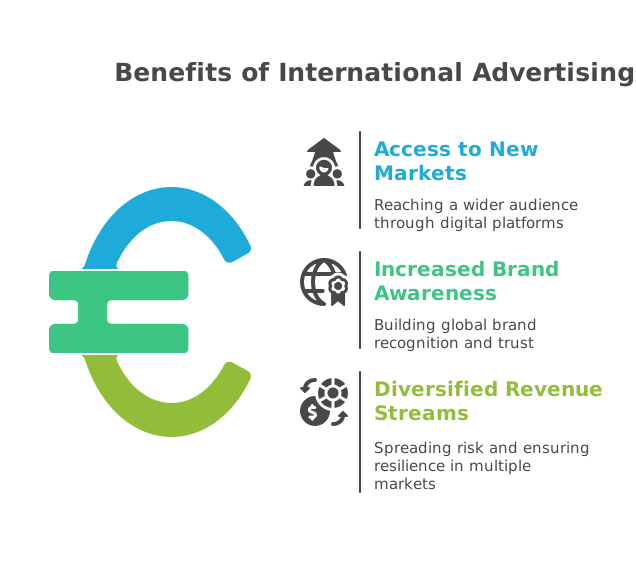
Access to new markets
One of the biggest benefits of international advertising is reaching a wider audience. Instead of limiting yourself to one market, you can introduce your products to millions of new customers worldwide.
The best part? Digital platforms like Google, Facebook, and Instagram make it easier to connect with international audiences.
These platforms allow you to target specific regions, ensuring that your ads reach the right people.
Increased brand awareness
Expanding into international markets helps build global brand recognition.
When people in different countries see your advertisements, it creates awareness and trust.
Your brand becomes familiar to a broad audience, strengthening its presence in new markets. This opens doors to new opportunities and partnerships that may not be available in just one market.
Diversified revenue streams
The global market offers the chance to diversify revenue streams. Relying on just one market can be risky, especially if that market experiences economic difficulties or increased competition.
Reaching customers in multiple countries spreads the risk and reduces dependence on any single market. This creates a safety net, making the company more resilient against economic changes and ensuring continued growth.
Embracing international advertising expands your reach, strengthens your brand, and opens doors to new opportunities. It helps you build a more resilient and innovative business in a global market.
Best Practices for International Advertising
For a successful international advertising, here are a few tips to consider:
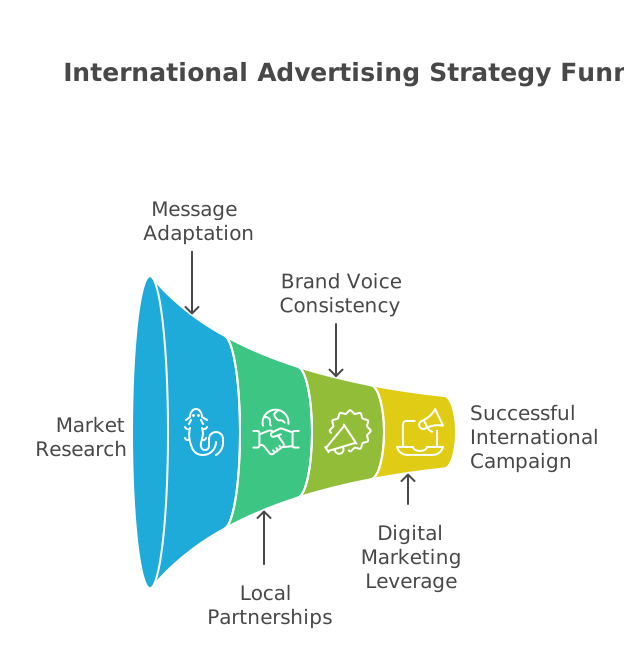
Research your target markets
Before starting an international advertising campaign, it’s crucial to research the regions you’re targeting.
Understanding the cultural, economic and social factors that shape buying behaviour in these areas will help you create more effective campaigns. This ensures that your message will resonate with local consumers.
Adapt your message
Translating your ads into another language isn’t enough to reach international audiences effectively.
What appeals to your home market may not connect with consumers in other regions. Instead, adapt and localise your message to fit the cultural context of each target market.
This could mean changing visuals, adjusting taglines, or even reworking the entire ad concept to align with local customs and values.
Work with local partners
Partnering with local agencies or experts is a smart move for international marketing. They understand the cultural nuances, legal requirements, and consumer preferences in their regions, helping you navigate these complexities.
Their insights can prevent costly mistakes and ensure your campaign connects with the target audience.
Use a consistent brand voice
Maintaining a consistent brand voice is crucial, even when tailoring your message for different markets. Consistency helps build trust and makes it easy for your global audience to recognise your brand.
You can adjust the tone and language to match local preferences, but the core values and personality of your brand should stay the same.
This balance ensures your brand connects with new audiences while staying true to its identity.
Leverage digital marketing
Digital platforms such as social media and search engines simplify reaching international audiences.
These tools offer targeted advertising options, allowing you to create ads that fit specific regions, languages, and demographics.
With digital marketing tools, you can track campaign performance in real time and make data-driven adjustments.
This helps you optimise your ads and ensures they effectively reach your target audience.
Implementing these best practices can help you create a successful international marketing campaign that resonates with diverse audiences.
This way, you can expand your reach and build a solid global presence while staying true to your brand identity.
Conclusion
International advertising isn’t just a marketing strategy for big corporations; it’s becoming increasingly accessible and crucial for businesses of all sizes in the global market.
Expanding your reach beyond borders will allow you to open a world of opportunities for growth, learning, and innovation.
Remember, success in international advertising doesn’t happen overnight. It requires thorough market research, cultural sensitivity, and a willingness to adapt.