In a global business world, the financial sector is increasingly turning towards premium financial translation, so that international stakeholders remain up to speed with their investment’s performance.
Developing a close relationship with a specialist translator is crucial for those in the financial industry, and especially for businesses operating in English and French speaking countries.
Firstly, as a technical field, the finance sector has a lot of its own specific terminology and complex ideas which specialists understand easily, but can seem very daunting to outsiders.
In addition, cultural and regulatory idiosyncrasies play a big role and should be kept in mind when translating from English to French.
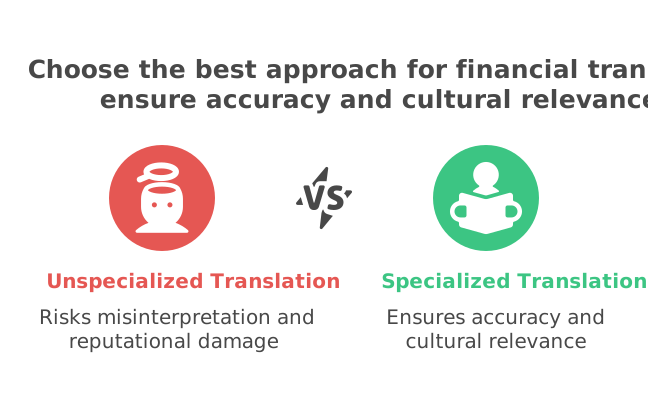
Financial translations that aren’t carried out by professionals, might allow the reader to get the gist of your message, but they will not precisely convey its originally intended meaning.
Poor communication can have a negative effect on your future viability, risking loss of trust from stakeholders, and meaning your potential failure to meet your client’s expectations.
Industry knowledge is key in financial translation
As you review your yearly balance sheet, you may wonder who else might be able to distinguish between accruals and realised profits or understand why prepayments are classified as liabilities.
Most people would agree that translating a document which seems completely unfamiliar is incredibly daunting, and there is potential for it to go very wrong.
Within financial translation an anectode has drew attention: an accountancy firm which had decided to delegate their balance sheet translation to an unspecialised translator, was surprised to notice that “stock” had been wrongly translated into “shares” in French, as opposed to “inventories”.
A mistake like this, which can damage a company’s reputation, could have been easily avoided if the translator had undertaken rigorous training, whether academic or professional, in the financial sector.
A professional French-to-English translator must also be aware of the guidelines regarding formatting, numbering, and terms in both countries.
The reason this matters is that certain English technical concepts have no French counterpart, such as EBITDA (earnings before interest, taxes, depreciation and amortisation).
Consequently, a professional translator must undertake a contextual analysis, in order to find the French equivalent; in this case, it could be BAIIA or EBT.
Also, from an editorial perspective, certain financial documents, such as investor reports, tend to obey different modes of expression, as they cater to readerships with different expectations of the document.
To address all the above risks, ideally, you should rely on a professional translator who has had experience working and/or studying in both a French and an English-speaking country.
Essential financial documents handled in financial translation
Key investor information documents (KIID)
Investment fund reports
Investor reports
Balance sheets
Income statements
Financial reporting guidelines
Bank documents
Information memorandums
Investigation papers
Risk management and asset management documents
Audit reports
One thing that these documents have in common is that they carry considerable weight in terms of the amount of information they contain and the business stakes they involve.
It is crucial to treat the translation of these documents with great caution because of the potential repercussions.
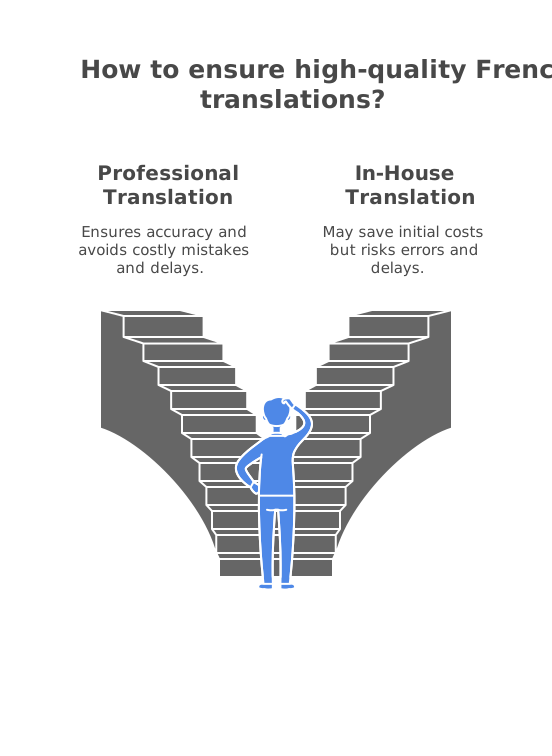
Low-quality French translations often result in an increase in the total costs of your operations, as you inevitably need to call upon a professional to clear up any mistakes.
Additionally, severe delays may occur if your financial presentations (or memos) fail to accurately convey the terms and conditions of your projects.
Finally, your company may suffer loss of reputation in French-speaking countries or incur lawsuits from your proposals being rejected by the local regulatory bodies.
It is important for your translation partner to measure these risks appropriately.
Often, specialist translatorshandle these challenges with the tools they use, which are able to manage terminology accuracy, and will include post-translation checks and proofreading in their services.
Find the perfect agency, build a long-term relationship
Building a long-term relationship with your financial translator ensures that your firm’s idiosyncrasies are well known, therefore limiting the possibility of your identity as a business being misrepresented.
The longer you work alongside a translation provider, the higher the quality of your documents will ultimately become, whether in French, German, or any other language.
To determine whether your partner is suitable, consider their degree of financial specialisation, shown by the qualifications or experience of the financial sector translators.
Also, make sure that your provider has a robust terminological base and can adapt to your preferences if need be.
Finally, make sure that communication between your firm and your provider is clear and honest to avoid costly mistakes and ensure your stakeholders ultimately remain perfectly informed; this will only benefit your business in the long run.
As a European company, we provide an online translation service to a wide range of businesses, irrespective of their geographical location, or field of work.
If there is one sector that requires having access to flawless and professional translations, performed by expert linguists and agencies, it is the insurance industry.
For this reason, many insurance companies have become regular returning customers for BeTranslated, as their expertise and specialist multilingual service is a valuable asset for insurers to have helping them with their technical linguistic needs.
We’re going to be delving deeper into the insurance industry’s current situation in the UK, hopefully giving you a better insight into the industry, as well as the professional translation services we can provide to you and your business.
Top insurance trends in the UK for 2024
Climate change: this growing issue has resulted in unprecedented damage to insured homes up and down the United Kingdom, which has seen a rapid rise in insurance prices.
Inflated rates: This is a knock-on effect of the inflation in repair costs, with businesses desperately attempting to balance their margins. It is estimated that the increase in the cost of insuring your home is set to get even higher, with the Financial Times predicting more than a 33% rise in the UK over the coming 2 years.
Car insurance prices are at an all-time high: A current nationwide shortage in vehicle parts and staff has resulted in insurers raising their rates. This issue extends beyond just car insurance, affecting various sectors such as campervan hire, where the costs have also seen a noticeable increase. Car insurance giant Admiral has predicted a plateau in inflated prices as early as 2024. However, this has been heavily debated amongst industry experts, with many believing we will continue to see an increase in rates up until 2025 at the very least.
Recovery period for the industry: the insurance industry has found itself in a recovery period, following the effects of Brexit, the COVID-19 pandemic, and Russia’s invasion of Ukraine. With all of these events happening in quick succession, every UK insurance market is still feeling the full effects. Another stand out issue for UK insurance providers at the moment, is the ever-changing international markets.
The impact of Brexit on the UK insurance market
Travel insurance, haulage insurance, and seafood insurance, have all seen, or experienced first-hand, the immediate effects and changes brought about by Brexit.
Passport problems have made it more and more challenging for UK and EU financial providers to reach a deal.
65% of its staff in London have already been relocated to Hong Kong, with the company’s new CEO being appointed in Hong Kong too.
Although its office in the capital is staying put, it appears Prudential has been forced to reconsider their future endeavours following the aftermath of Brexit, with the renowned insurance company seemingly having its primary focus on the Asian market.
Brexit appears to have affected 60% of the commercial insurance industry worldwide, however, it is claimed to have impacted upon a staggering 100% of UK insurance companies.
Despite the previously mentioned factors having a significant impact upon the industry (COVID-19, climate change, and the war in Ukraine), experts unanimously agree that Brexit has been responsible for the vast majority of the UK insurance industry’s current deplorable state.
Insurance in the City of London
The London Market is unique, and independent of the rest of the UK.
It attracts a lot of global interest, so much so that out of the total instalments that take place, only 30% are UK-based, with the rest being received from clients overseas.
It is the only active market to have the top 20 assured reinsurance companies all present.
Over the past few years, we have witnessed an increase in the scrutiny surrounding high-exposure risks.
Insurance providers in London primarily specialise in non-life insurance, along with reinsurance.
The London Market is undergoing a technological advancement, with 33% of active insurers investing in new technology.
Insurers want to ensure that an efficient and flawless service is on offer for every broker and client.
Translation for insurance companies
Insurance companies work with industry-specific documents, for example, company policies and contracts, etc.
They often translate these technical documents in order to fulfil the legal and commercial requirements of the market, to which the insurance company is directed, depending on the nationality of the policyholder.
Founded in 2002, BeTranslated has provided numerous widely recognised insurance translation services to all kinds of experienced and assured businesses within the financial sector.
The following fields do not pose any difficulty whatsoever for our translators, as the databases which have been accumulated since the launch of BeTranslated, guarantee ultimate precision in any type of translation carried out.
BeTranslated is a professional translation agency that works with multiple linguistic combinations, be it translating an insurance policy in PDF format, from English to Spanish, or from French to German, or any other language.
Why use BeTranslated’s insurance translation services?
To help facilitate your international communication, we offer reviews and insurance translation services of the highest quality to insurance companies.
Our professional translators, who are industry experts, work under tight deadlines so that you can communicate with your clients and colleagues, whether they are in Spain, Europe, or anywhere else in the world, no matter your first language.
Take care when using online translation tools, as they make plenty of mistakes, and end up costing some companies a lot of money in the process.
Your communication is the face of your business, and it has to be impeccable!
Quotes and an efficient, speedy service… We are at your disposal 24/7
Whether it is insurance policies for properties, vehicles, housing, families, pensions, finances, etc., insurers take care of the most personal and private affairs of their clients, with confidentiality being essential.
With BeTranslated, our clients can rest easy knowing that we respect the confidentiality of their documents throughout the process.
Our industry-expert insurance translators respect the demands of the client, and promise to provide a translation service that is compliant with the very strict rules of the profession.
A press release is a short document, whose goal it is to inform and keep journalists, and the public updated about your business’ events and innovations.
Whether it is regarding the launch of a company, or the release of a new product, press releases allow you to establish an effective line of communication with the public.
This is where press release translation services are necessary.
A press release translation into multiple languages, gives your document the opportunity to get noticed globally.
Let’s say that your company wants to step onto the international scene, this will help to grab everyone’s attention.
Translating a press kit can be a very powerful and crucial marketing strategy, and it can allow your company to be very well understood by your target audience.
Why do you need press release translation services?
It might be that you would like to publish a press release as soon as possible, but do you think that it will connect with a multilingual audience if your publications are only available in one language?
If your press releases are only available in English, it is possible that you could miss the opportunity to reach out to a much wider audience.
By translating them into other languages, you can reach out to journalists, the media, and audiences that you would not have reached out to otherwise.
If you provide the information in other languages, you demonstrate that you are invested in clear and effective communication.
Of course, the first step is to find the right translation agency to help you launch your press kits into the global market.
Press release translations are a crucial marketing strategy
It goes beyond simply reaching a wider audience; it’s about ensuring that your core message, the information you want to convey, resonates with individuals from diverse linguistic backgrounds.
As you begin to put together your press releases, it’s important to bear in mind the quintessential nature of a well-crafted press release, which should effectively address the five fundamental questions:
Who
This question pertains to the individuals or entities involved in the subject matter of your press release. It’s about identifying the key players, whether they are organizations, individuals, or groups, allowing your audience to understand the context and relevance of the news.
What
This is the crux of the matter. What is the news? What are the developments or events you are announcing? This question delves into the heart of the matter, revealing the substance of your message.
When
The timing of your news is crucial. It helps your audience understand the relevance and urgency of the information. Is it a recent development, an upcoming event, or a historical retrospective? Answering the “when” question provides context and immediacy.
Where
This question concerns the location or scope of your news. It’s about geography, be it a specific place, a global perspective, or even a virtual space.
Defining the “where” helps your audience place the news in a specific context.
Why
The “why” question delves into the motivations, reasons, and significance behind the news. It’s your opportunity to explain the purpose and the impact of the subject matter.
Why is this news important, and why should your audience care?
By addressing these five fundamental questions in your translated press releases, you ensure that your message resonates comprehensively and effectively with your target audience, regardless of their language and cultural background.
This not only expands your reach, but also strengthens your ability to connect with diverse markets across Europe, Asia, and America, ultimately contributing to the success of your global marketing endeavours.
Furthermore, translating your English documents into neighbouring languages, such as French, German, or Italian, can help expand your market reach across close borders.
A press release’s quality
Only an experienced translation agency will be able to offer you optimal exposure of your press releases in multiple languages.
You can trust in BeTranslated’s professional translators to provide you with a high-quality translation in a very short time, and at a competitive rate.
Furthermore, we ensure that your company grows globally and leaves your target audience with a positive and respectable image of your brand.
When writing up a press release about your company online, it is important that it is informative, and follows the quality standards required by many media platforms.
Our translation agency is responsible for guaranteeing loyalty to the original document, as well as the quality of the final product.
Being loyal is not the same as being literal.
The precision and the thoroughness of our translators’ work lie precisely with your know-how, which allows them to establish this distinction, and therefore adapt a text to a cultural setting, which is inevitably different to that of the original language.
We ensure that our translations are precise and remain loyal to the original message.
Simultaneously, we carry out a localisation process, which allows us to adapt the translation to the very heart of the culture of the chosen country.
Time factor of press release translation
Everyone will tell you that the timetaken with press release translation is a determining factor. Editors worldwide demand that the presented information is relevant, but above all, handed in on time for publication.
For this reason, quality isn’t our only priority.
At BeTranslated, we are very strict with deadlines, and our professional translators are used to working under tight time constraints.
We will work together to ensure that our team completes your press release translations, returning them to you within the agreed timeframe.
This way, you will be able to broadcast synced press releases internationally.
Trust BeTranslated for your multilingual press release translation services
Our extensive experience and unwavering commitment to quality make us an ideal ally for any of your projects.
Our proficiency spans across various sectors, aligning perfectly with our aim to cater for a wide range of industries.
Don’t hesitate to get in touch with us to find out more about our services.
With businesses and retail brands now offering an online service to their customers, it is increasingly difficult for webpages to achieve a high ranking in search engines and algorithms, infringing upon their visibility towards their network of potential retailers and consumers.
It is here that the process of SEO translation comes into play.
Search engine optimisation has become a key marketing strategy and solution for businesses, whose objective is to have a strong e-commerce presence, in order to easily connect and reach consumers via the internet.
Fortunately, BeTranslated can lend a helping hand, with a team of worldwide translators at our client’s disposal, who are not only specialised in translation but as well as SEO translation and optimisation.
The team shares one common goal, which is to effectively increase the reach and visibility of any given brand.
The process of SEO translation
The process of SEO translation not only requires translating content from one language to another, such as English to French, it also requires taking into account several other factors.
Firstly, keywords must be defined, taking into consideration popular research terms, searches, and phrases, including cultural nuances based on search volumes provided by a set of tools, such as Ahrefs, Semrush, Keywordtool.io or Ubersuggest.
This helps to have a wider scope, providing a better ranking and positioning.
Then, an optimal translation of the content is carried out.
The user’s experience is mainly considered, that’s to say the way that the business, the brand, or the product is researched in each language and each region in order to optimise it in the best way possible.
The goal is to communicate with the audience on a large scale.
Search intent is also taken into consideration when optimising a piece of content or a webpage, that is to say if a customer is looking for information about a product or to directly purchase a product.
However, even with these strategies, it doesn’t end there. The content must sound natural and be easy to read for the user if you want them to carry on reading the page.
SEO translation and the importance of context
This approach to multilingual translation responds effectively to Google’s requirements in terms of relevant content, which allows access to a better context adaptation, essential for positioning and for facilitating a precise and effective measure of results.
Online translations are crucial for the SEO optimisation of webpages, and this is where IT outstaffing comes into play.
Online translation agencies and translation companies also play an important primary role in this field. With the ever-growing competition in the digital industry, the global visibility of brands and SEO translations have become a vital target and project within the sector.
SEO translation takes into account many factors, notably the research of keywords and a user’s experience in every language, country, and region.
Language service providers, like BeTranslated, offer and deliver quality translations on time, with keywords being optimised for reference and adapted to the criteria of each market.
Thanks to their extensive knowledge, you are guaranteed to have the highest visibility within search engines, so that you can connect to local and foreign clients, which in turn boosts your credibility.
The advantages of translation with SEO optimisation
The professional translation of webpages’ content into other languages allows a company to increase their recognition internationally, by reaching out to a multilingual audience.
Moreover, expert human SEO translation improves their image, as this shows the conscious effort made by the business to better understand other countries and their cultures. Naturally, from a SEO positioning point of view, it is a considerable and major benefit.
Having a webpage’s contents in different languages will incite the search engines to include this content in search results in various locations, increasing the visibility of the brand in each language.
SEO expertise: a huge impact on your translations
Even though SEO translation is important for improving the international visibility of businesses, it is worth noting that the quality of the translation must not be ignored.
Poor translations are a common issue, and they can harm the image of the brand, as well as the user’s understanding of the messages conveyed by the content.
Our team at BeTranslated, ensures the quality of our translations by calling upon native speaking translators, as well as carrying out rigorous quality assurance checks.
Furthermore, our SEO expertise allows us to maximise the impact of our translations on a company’s positioning within search engines.
For a more strategic approach towards your SEO, beyond drafting, you could also get in touch with BeTranslated, as we offer SEO consulting services.
Furthermore, we adapt to the specific criteria of each keyword, and to the positioning strategy, meaning your site will be guaranteed to appear on the first few pages of Google, websites, e-commerce, or blogs, allowing retailers to browse the site, which will increase your sales.
Why should you use our professional translation agency?
Our expert team of highly specialised translators here at BeTranslated is at your disposal, ready to lead the necessary processes required for your project, ensuring that your website is using the correct terminology and slogans, so that your company can operate and perform to its full capacity.
Furthermore, you will be able to compete with the largest companies locally and globally by expanding your client base.
Here at BeTranslated, we specialise in SEO translation, and we understand how vital it is to stay a step ahead of your competitors.
With our localisation expertise and help, we can offer localised content, which drastically improves your user’s experience, and allows your company to earn a client’s trust whilst simultaneously boosting your credentials.
Navigating the job market can be like walking through a maze, especially when you’re trying to enter a specialised field like translation.
But don’t fret; it’s far from impossible.
You’ve got skills, you’ve got passion, and after reading this article, you’ll have the roadmap you need to land your dream job in the translation industry.
Know Your Strengths and Weaknesses
Before diving head-first into job applications, take a step back and evaluate your own skill set.
What languages do you speak fluently? Are there any specific industries you’re particularly knowledgeable about—like law, medicine, or technology?
Having a clear understanding of your strengths and weaknesses will not only help you target the right job opportunities but also give you a competitive edge when customising your CV and cover letters.
Speaking of which, crafting an impeccable CV is crucial.
Crafting a Winning CV
In the UK job market, your CV is more than just a piece of paper; it’s your professional passport. It’s what gets your foot in the door and sets the stage for an interview.
If you’re not familiar with the CV format common in the UK, take some time to research and adapt your existing CV to it.
There are numerous templates available online to get you started, but for those wanting a bit more flair, Adobe Express offers a range of creative yet professional CV templates you can utilise.
They also have a range of design tools that you can use to craft your CV from scratch.
Beyond format, focus on the content.
Highlight your language proficiencies, relevant work experiences, and any translation-specific certifications you might hold.
Remember, it’s not just about showcasing your skills but also demonstrating how you can add value to a potential employer.
Get Certified, Get Ahead
While not a strict requirement for all translation jobs, getting certified can significantly boost your chances.
In the UK, you can consider accreditations like the Diploma in Translation (DipTrans) from the Chartered Institute of Linguists or membership with the Institute of Translation and Interpreting.
These credentials not only validate your skills but also make you more appealing to employers, who see value in certified professionals.
Certification programs often include both theory and practical exams, covering various translation techniques and subject matter expertise.
By successfully completing these, you’re essentially demonstrating your readiness to tackle professional assignments.
Freelance vs In-House
At some point, you’ll need to decide between freelancing and working in-house. Both have their merits and drawbacks.
Freelancing offers flexibility and the freedom to choose projects, but it also means inconsistent income and the hassle of running your own business.
On the other hand, in-house positions offer stability and often come with benefits like healthcare and retirement plans, but you might find yourself stuck with projects that don’t particularly interest you.
Consider your lifestyle, financial situation, and career goals when making this decision. Some people start with freelancing to build a portfolio and then transition to an in-house role, while others find freelancing to be their lifelong calling.
Learn to Network
Many people groan at the thought of networking, associating it with awkward conversations and forced smiles.
However, when done right, networking can be your secret weapon in breaking into the translation industry.
Attend industry-specific events, webinars, or even online forums where you can connect with like-minded professionals.
And don’t just limit yourself to other translators; clients, agencies, and even educational instructors can offer invaluable insights and opportunities.
LinkedIn can be a great platform for networking as well. Engage with content, share your own insights, and don’t hesitate to connect with professionals in the field.
You never know; your next job offer might just be a DM away.