In our increasingly globalised world and thanks largely to the internet, expanding into international markets is a reality for many businesses.
Most companies are well aware of the importance of having an active online presence, but this digital content is of no use to potential international customers if they can’t understand it. Hence the importance of a multilingual website.
Having your website translated by a professional translation service will make your products or services accessible to new clients and allow them to feel connected to your brand.
But why are multilingual websites so important, and what factors need to be considered when translating them? Let’s take a look.
Translate your website for strong customer relations
Studies show that 55% of customers prefer to shop in their own language : who can blame them?
Navigating the web through your native language is not only a much more relaxing user experience that eliminates the chances of misunderstandings, but it also makes you feel like the company is speaking to you, that their products or services are for you.
These days many web browsers offer instant machine translation of websites and, while this function can be useful in a pinch, the quality is extremely low which leaves users feeling frustrated and confused.
Customers can’t be blamed for questioning why they should give money to a company that has made no effort to make their digital content accessible.
Is this the impression you want your business to give?
By hiring a professional translation service to translate your website, you will open your business up to a whole new world of potential clients!
Your multilingual website should be easy to find
As well as helping you create strong relationships with prospective clients, translating your website into relevant languages actually increases your search engine rankings, making it easier for your company to be found online.
This is because having your content available in multiple languages means it appears in keyword searches in those languages, not only English, giving your business better exposure.
While we’re on the topic of SEO and search engines, it’s worth acknowledging that around the world different search engines are used: in Russia people use Yandex, in China it’s all about Baidu whilst in South Korea, Naver far outperforms both Google and Yahoo.
It pays to research how people use the internet in the country your business wants to expand into to give your website the best chance of being found by potential customers.
Make switching between languages easy
It’s all well and good making your website available in multiple languages, but if people can’t find the language switcher, they will be stuck viewing the site in English regardless!
It should be an intuitive process so that users don’t have to waste time and get bored. Most websites opt to place the language switcher at the top right-hand side of the page, so this is usually the best option.
Once you’ve settled on the position of the language switcher, you have to decide if you’re going to use flags or words to indicate the languages (or both, though this can look overcrowded).
Flags have the advantage of being visually appealing and simple, but can be rather exclusive; think about all the countries that speak Spanish, for example, they won’t feel represented by a Spanish flag.
If you decide to use words, we recommend having the language written in the relevant languages, i.e. the button should read ‘Deutsch’ instead of ‘German‘ or make it easier for users to find.
Localisation can be just as important as translation
Translating the verbal content of your website is only part of what goes into creating a successful multilingual website; you should work with a translation agency that can also localise your site.
Localisation is the process of altering content, whether that’s a website, a video, or a brand’s advertising campaign, to make sure it is received in the appropriate manner by the target audience, taking culture into account.
When it comes to localising websites, things to consider include images, date and address formats, and brand slogans, to name a few.
How to ensure an efficient translation process
Allowing your translator access to links to the original website they are translating will make life much easier and ultimately result in better translations.
Translation does not exist in a vacuum and knowing if the text they are working on is an image caption, a CTA (call to action), or button will inform how a translator renders it. Similarly, communicate with your translation agency about the best format for the source and target texts.
This will help both your translator and webmaster, who is not likely to understand the target text.
Now that we’ve convinced you of the importance of having a multilingual website, perhaps you’d like more information about BeTranslated’s talented website translators? For more information or a free, no-obligation quote, get in touch today.
Few British sitcoms have travelled the world quite like The IT Crowd. Beneath the slapstick and geek-chic humour sit layers of cultural reference, class-tinged slang and deliberately absurd phrasing that rarely survive a straight translation. For non-native speakers — and anyone watching with subtitles — these are often the lines that get lost.
We’ve rounded up ten of the show’s most challenging expressions and explained what makes each one tricky. If you work with British content for your business — a website, an ad campaign, a training video — these are exactly the patterns that need a skilled translator or localiser rather than a word-for-word approach.
1. “Have you tried turning it off and on again?”
Roy’s catchphrase is so ubiquitous in the UK that it has escaped the sitcom and entered everyday speech. The joke only lands if you recognise the tone: flat, sarcastic, and usually delivered without looking at the caller. In translation, the words are easy; the register — that dry, “I’ve said this a thousand times” delivery — is the challenge.
2. “I’m disabled”
Roy deploys this phrase to duck out of awkward situations, riding on a misunderstanding set up earlier in the episode. It’s clearly not meant literally, but without the scene’s context the line reads as insensitive. Translators need the setup before they can decide how to render the gag in another language.
3. “People. What a bunch of bastards.”
Roy’s misanthropic one-liner sums up a very particular strain of British humour — grumpy, self-aware, almost affectionate. “Bastards” sits far lower on the offence scale in everyday UK English than its equivalents in many other languages. Getting the weight right in the target language is the translator’s job.
4. “I came here to drink milk and kick ass. And I’ve just finished my milk.”
A deliberate parody of a famous line from the 1988 film They Live: “I have come here to chew bubblegum and kick ass… and I’m all out of bubblegum.” Swap bubblegum for milk and you get a joke about masculinity delivered with absolute deadpan. Miss the reference and the line is just confusing.
5. “Did you see that ludicrous display last night?”
Moss attempts small talk about football and produces something that sounds plausible on the surface but means nothing to anyone who actually watches the sport. The humour sits in the awkward gap between the character and the subject — and that gap is culture, not vocabulary.
6. “A fire? At a Sea Parks?”
Roy’s irrational obsession with this imagined catastrophe becomes a running joke. It’s funny because it’s utterly specific and utterly pointless — the kind of absurd, niche premise British comedy loves. Translators need to decide whether to preserve the wording, adapt it, or occasionally swap it for a culturally equivalent absurdity.
7. “I’m going to murder you… you bloody woman!”
Douglas’s theatrical outburst is comedy precisely because it’s so obviously over the top, but a literal subtitle can feel startling. “Bloody” is an intensifier that has softened considerably in modern British English — it sits far lower on the offence scale than, say, a French or German equivalent that involves “blood”.
8. “It’s not like I’m a window cleaner or something.”
This line leans on British class stereotypes, where window cleaning is shorthand for a salt-of-the-earth trade. Strip out the class reference and the line stops being funny. In translation, it often requires a different occupation — one that carries comparable resonance in the target culture.
9. “You there, computer man. Fix my pants!”
Douglas’s command is funny for two reasons: his casual dismissiveness towards the IT team, and the unexpected request to fix clothing. American viewers hit an extra layer — in US English, “pants” means trousers; in UK English, “pants” means underwear, which only makes the request weirder.
10. “Them glasses is shit, innit?”
Deliberately incorrect grammar, working-class London delivery and the tag question “innit” — this single line is a masterclass in linguistic caricature. For learners of standard English, it’s both off-putting and enlightening, because it reflects how real British English sounds on any given street.
Why British comedies are such a useful window into the language
Shows like The IT Crowd, Fleabag and Peep Show condense enormous cultural information into a few short scenes. Class markers, regional accents, historical references and social conventions all appear in one piece of dialogue. That’s why they’re brilliant for language learners — and why they’re tricky for automatic subtitles and machine translation to handle convincingly.
The same patterns show up in business content. A brochure aimed at a British audience will lean on understatement, dry humour and quiet confidence. Translate it literally into another language and the tone falls flat; the words arrive but the personality does not.
Translating British humour, professionally
At BeTranslated, we work with native linguists who understand the difference between translating the words and translating the joke. Whether you’re adapting UK marketing for international markets or bringing foreign content into British English, culturally aware localisation is what separates a message that travels from one that stalls.
If your content depends on tone, references or humour to land, don’t leave it to a machine. Request a free quote and we’ll match your project with a translator who gets it.
Frequently asked questions
Does British humour really make translation harder?
Yes. British humour relies heavily on understatement, irony, class references and cultural context — all of which resist a word-for-word approach. A skilled translator will adapt the reference or the register rather than just the vocabulary.
Can machine translation handle scripts like The IT Crowd?
Machine translation has improved dramatically but still struggles with sarcasm, deliberately wrong grammar, cultural in-jokes and intentional misuse of register — all staples of British sitcom writing. For subtitles, dubbing or any creative content, human review is essential.
I’m learning English in the UK. Should I watch British comedies?
Absolutely — but pair them with context. Keep subtitles on at first, pause to check unfamiliar slang, and don’t expect to catch every reference immediately. Over time, sitcoms teach you rhythms and idioms that coursebooks miss.
How does BeTranslated handle humour in business content?
We match projects with translators who specialise in the target market and understand the tone you’re aiming for. For campaigns or content that rely on wit, we typically recommend transcreation — adapting rather than translating — so the humour lands in every language.
Which British expressions are most commonly misunderstood abroad?
The ones that lean on tone rather than vocabulary. “Not bad” often means “really quite good”, “quite interesting” can be a polite dismissal, and “with respect” frequently introduces criticism. Standard in UK English, tricky to render elsewhere.
Football in Britain isn’t just a sport. It is a reflection of who we are—from muddy Sunday league pitches to packed Premier League grounds on cold winter nights. Every generation of British footballers tells a story about the country itself. From David Beckham’s global fame to Jude Bellingham’s composed brilliance, these players have defined decades of style, pride and shared emotion.
Football lives in every corner of the country: from Manchester’s rainy training grounds to Birmingham’s community pitches, from the seaside shouts of Brighton to the roaring terraces of Liverpool.
It connects regions, accents and generations in a way few things can.
And just as football connects nations through sport, BeTranslated connects them through language—carrying British culture, humour and identity into new markets.
The legends who built the foundation
Before social media and sponsorship deals, there were players who built the roots of the game. Bobby Charlton, Bobby Moore and George Best became national heroes through sheer skill and personality. Charlton and Moore embodied post-war optimism and integrity, while Best brought glamour and rebellion—a taste of pop culture to the pitch. Their triumphs, especially the 1966 World Cup win, gave Britain a sense of unity and pride that still echoes today.
They showed the world that British football could be elegant, fearless and full of character.
Photograph: Popperfoto/Getty Images
The global era: Beckham and the rise of the celebrity footballer
David Beckham changed what it meant to be a footballer. With his free kicks, tattoos and fashion sense, he became Britain’s first global sports superstar. He made football stylish, bridging sport and celebrity culture while exporting British football to every corner of the planet. His story—beginning in east London and celebrated from Manchester to Madrid—shows how a player’s journey can bridge local roots and global fame.
He showed that a British player could be both local hero and global brand, inspiring a new generation to dream beyond the stadium.
Beckham’s rise demonstrated how British culture could travel far beyond its shores—a kind of global communication that BeTranslated champions every day, helping British brands and voices reach new audiences.
Image credit: Getty Images
The modern generation: Kane, Sterling, Rashford and Saka
A new wave of footballers has redefined what it means to represent Britain. Harry Kane leads with quiet determination and a sense of loyalty that feels timeless. Raheem Sterling has used his voice to challenge racism and push for fairer treatment in football and the media. Marcus Rashford has become a national role model, tackling child poverty and education reform while excelling on the pitch.
Then there is Bukayo Saka—bright, grounded and endlessly positive.
When Saka, Rashford and Jadon Sancho were targeted with racist abuse after the Euro 2020 final, it exposed an ugly side of English football fandom. Yet the response that followed showed a very different side of the country—one that stood by them, defended them and made clear that racism has no place in British sport.
Together, this generation plays with purpose and pride. They reflect a modern Britain that is diverse, socially aware and unafraid to stand up for what matters.
Photograph: Alex Livesey/The FA/Getty Images
The new standard: Jude Bellingham and the future of British football
Jude Bellingham is the face of British football’s future. Mature beyond his years, confident without arrogance and already commanding the world stage, he symbolises the next chapter of the national game. He combines the grace of old-school players with a modern professionalism that makes him a role model for a new era. Bellingham’s success abroad shows how far British football has come.
No longer confined to its own league, it now produces players ready to compete, lead and inspire anywhere in the world.
Adam Davy / PA Wire
The underrated British footballers
Not every great player becomes a headline. Some, like James Milner or Leighton Baines, built their reputations quietly through consistency and hard work. Their dedication kept clubs stable and standards high.
Others, such as Karen Carney and Eniola Aluko, helped transform women’s football in Britain, paving the way for the Lionesses’ rise. The Lionesses’ triumph at the 2022 UEFA Women’s Euro changed everything.
Under Sarina Wiegman’s calm and tactical leadership, England lifted a major international trophy for the first time since 1966. Players such as Leah Williamson, Lucy Bronze and Beth Mead set new standards for visibility and excellence. Rising talents like Lauren James and Michelle Agyemang show how deep the pathway now runs, inspiring girls to see football as a space where they belong.
Their victory was more than a sporting milestone—it was a cultural moment that shifted perceptions of the game in Britain forever.
Getty Images
Football as British identity and legacy
Football mirrors Britain’s spirit. It connects people across class, background and geography. From the terraces of the sixties to the global arenas of today, British footballers have reflected the country’s evolution. Charlton and Moore gave Britain pride. Beckham gave it glamour. Sterling, Rashford and Saka gave it conscience. Bellingham is giving it its future. The Lionesses have shown that victory, leadership and inspiration belong equally to women.
Football remains Britain’s favourite form of self-expression. It unites, entertains and sometimes breaks hearts—which is exactly why it matters.
British football is more international than ever, and so is the language that surrounds it. If you want your own British story to reach the world, we at BeTranslated can help share it—making sure the passion behind every goal and headline is understood worldwide.
BeTranslated specialises in translating cultural and sporting content so that British voices, brands and stories travel as widely as the game itself.
To make your British story travel as far as the beautiful game, contact us.
Have you ever wondered how some businesses seem to have a presence no matter where you are in the world?
Well, that’s the power of international advertising!
Nowadays, businesses aren’t just serving the local markets: they’re spreading their messages across the globe, tailoring their approach to different cultures and languages.
But how do they manage to do it? And why is it vital?
This article breaks down what international advertising is all about. Read on for key benefits and practices for a successful global marketing strategy!
What is international advertising?
International advertising is the process of promoting a product or service in multiple countries or regions. It goes beyond simply translating existing marketing materials into other languages.
Effective advertising campaigns require adapting your messaging to fit different cultural norms, local preferences, and economic conditions.
When expanding to global markets, strategic international media buying and planning is crucial for reaching the right audience. Different regions may favour various platforms, such as TV, social media, or print.
To succeed, it’s essential to choose the best channels for each international market and adapt your content to local preferences.
What are the benefits of international advertising?
If you’re wondering why you should consider global advertising, here are a few reasons:
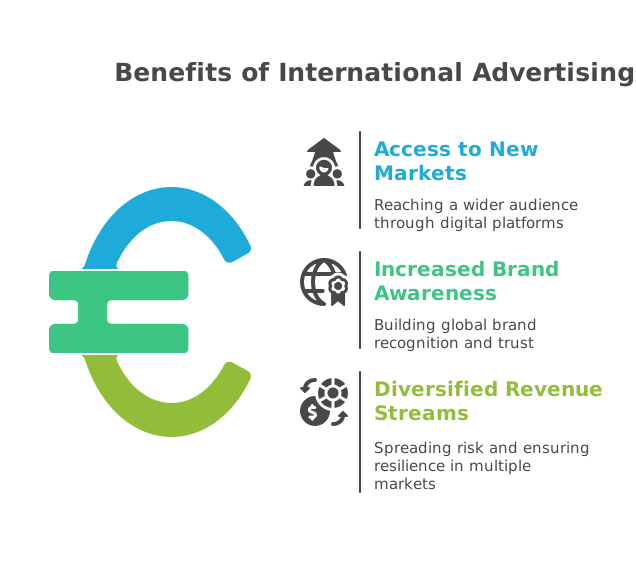
Access to new markets
One of the biggest benefits of international advertising is reaching a wider audience. Instead of limiting yourself to one market, you can introduce your products to millions of new customers worldwide.
The best part? Digital platforms like Google, Facebook, and Instagram make it easier to connect with international audiences.
These platforms allow you to target specific regions, ensuring that your ads reach the right people.
Increased brand awareness
Expanding into international markets helps build global brand recognition.
When people in different countries see your advertisements, it creates awareness and trust.
Your brand becomes familiar to a broad audience, strengthening its presence in new markets. This opens doors to new opportunities and partnerships that may not be available in just one market.
Diversified revenue streams
The global market offers the chance to diversify revenue streams. Relying on just one market can be risky, especially if that market experiences economic difficulties or increased competition.
Reaching customers in multiple countries spreads the risk and reduces dependence on any single market. This creates a safety net, making the company more resilient against economic changes and ensuring continued growth.
Embracing international advertising expands your reach, strengthens your brand, and opens doors to new opportunities. It helps you build a more resilient and innovative business in a global market.
Best Practices for International Advertising
For a successful international advertising, here are a few tips to consider:
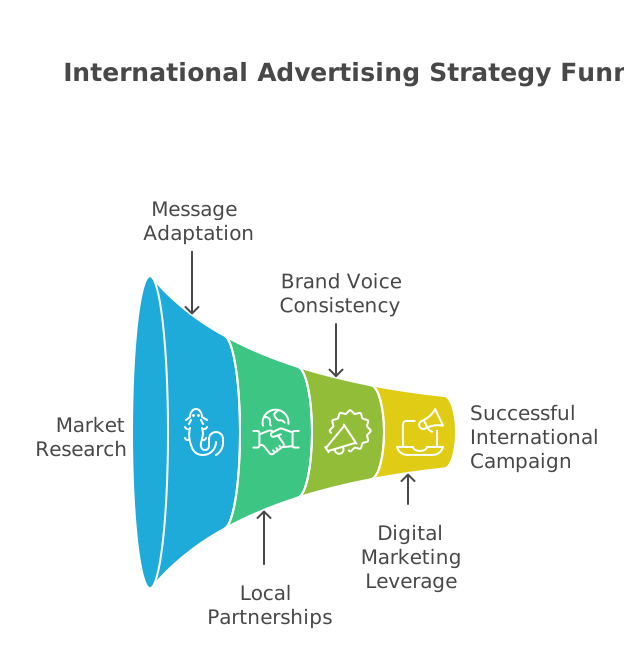
Research your target markets
Before starting an international advertising campaign, it’s crucial to research the regions you’re targeting.
Understanding the cultural, economic and social factors that shape buying behaviour in these areas will help you create more effective campaigns. This ensures that your message will resonate with local consumers.
Adapt your message
Translating your ads into another language isn’t enough to reach international audiences effectively.
What appeals to your home market may not connect with consumers in other regions. Instead, adapt and localise your message to fit the cultural context of each target market.
This could mean changing visuals, adjusting taglines, or even reworking the entire ad concept to align with local customs and values.
Work with local partners
Partnering with local agencies or experts is a smart move for international marketing. They understand the cultural nuances, legal requirements, and consumer preferences in their regions, helping you navigate these complexities.
Their insights can prevent costly mistakes and ensure your campaign connects with the target audience.
Use a consistent brand voice
Maintaining a consistent brand voice is crucial, even when tailoring your message for different markets. Consistency helps build trust and makes it easy for your global audience to recognise your brand.
You can adjust the tone and language to match local preferences, but the core values and personality of your brand should stay the same.
This balance ensures your brand connects with new audiences while staying true to its identity.
Leverage digital marketing
Digital platforms such as social media and search engines simplify reaching international audiences.
These tools offer targeted advertising options, allowing you to create ads that fit specific regions, languages, and demographics.
With digital marketing tools, you can track campaign performance in real time and make data-driven adjustments.
This helps you optimise your ads and ensures they effectively reach your target audience.
Implementing these best practices can help you create a successful international marketing campaign that resonates with diverse audiences.
This way, you can expand your reach and build a solid global presence while staying true to your brand identity.
Conclusion
International advertising isn’t just a marketing strategy for big corporations; it’s becoming increasingly accessible and crucial for businesses of all sizes in the global market.
Expanding your reach beyond borders will allow you to open a world of opportunities for growth, learning, and innovation.
Remember, success in international advertising doesn’t happen overnight. It requires thorough market research, cultural sensitivity, and a willingness to adapt.
Translator vs Interpreter: Understanding the Key Differences for Your Business
Running a business in today’s interconnected world? Chances are you’ll need linguistic support, whether that’s a translator or an interpreter. But here’s the thing: these aren’t interchangeable roles, despite what many people think.
The demand for language services has absolutely skyrocketed in recent years.
We’re living in an era where remote teams span continents, international partnerships are the norm, and even local markets are increasingly multicultural. Add in the rise of digital nomadism and hybrid working, and you’ve got a recipe for serious linguistic complexity.
Whether you’re expanding into new markets, managing a diverse workforce, or simply trying to connect with your multilingual customer base, getting your language strategy right isn’t just helpful: it’s essential for success.
Now, here’s where it gets interesting. Most people use “translator” and “interpreter” as if they’re the same thing. Spoiler alert: they’re not.
These professionals might both work with languages, but they’re operating in completely different worlds with distinct skill sets.
Let’s dive into what makes these roles so different and help you figure out which one your business actually needs.
Translator vs Interpreter: the key differences explained
Both translators and interpreters bridge language gaps, converting messages from a “source” language into a “target” language. But that’s where the similarities end.
Think of it this way: if languages were transport, translators would be the careful cartographers mapping out the perfect route, whilst interpreters would be the skilled drivers navigating traffic in real-time.
Here are the eight crucial differences that’ll help you choose the right linguistic service for your needs:
Written vs spoken: the fundamental divide
This is the biggie. Translators work with written content documents, websites, contracts, marketing materials. They’re the ones hunched over computers, crafting the perfect turn of phrase, usually translating into their mother tongue.
They’ve got dictionaries, glossaries, CAT (Computer-Assisted Translation) tools, and even AI-powered assistants at their disposal. In 2025, many translators are leveraging advanced AI tools whilst maintaining the human touch for cultural nuance and context.
Interpreters, on the other hand, work with spoken language in real-time. They’re the linguistic ninjas who can listen in one language and speak in another, often simultaneously. No Google Translate to fall back on: just their brain, their training, and their ability to think on their feet.
Thanks to improved video conferencing technology and high-quality audio equipment, remote interpreting has become incredibly sophisticated. Many interpreters now work virtually, connecting global teams seamlessly without leaving their home office.
Need an interpreter for your customer service centre? Absolutely. With international clients expecting support in their native language, having real-time interpretation can transform your customer experience and boost your global reputation.
Pricing models: time vs words
Here’s where your budget planning comes in.
Translators typically charge per word or page, making it easier to predict costs for large projects. Current market rates vary significantly based on language pair, specialisation, and urgency.
Interpreters usually work on hourly or daily rates, with additional charges for travel (though remote work has changed this landscape considerably).
Premium rates apply for specialised fields like medical or legal interpretation.
Working at different speeds
Translators have the luxury of time (relatively speaking).
They can research terminology, check references, and polish their work before hitting send.
Interpreters work at the speed of human speech: no pause button, no second chances.
They might prep beforehand if they know the topic, but once the conversation starts, it’s all happening in real-time. It’s linguistic gymnastics at its finest.
Language direction: one-way vs multi-directional
Most professional translators work into their native language only. It’s about achieving that perfect, natural flow that only a mother-tongue speaker can provide.
They’re not just converting words: they’re enabling relationships.
Location, location, location
The pandemic fundamentally changed how we think about workplace flexibility. Translators were already ahead of the curve, working remotely long before it was trendy. This gives businesses access to global talent pools and competitive pricing.
Interpreters traditionally needed to be physically present, which limited options and increased costs. However, virtual interpreting services have revolutionised the industry. High-definition video, crystal-clear audio, and reliable internet connections mean quality interpretation is now available from anywhere in the world.
Tools of the trade
Modern translators are tech-savvy professionals. They use CAT tools, terminology databases, AI-assisted platforms, and cloud-based collaboration systems. Many work with neural machine translation as a starting point, then apply human expertise for quality and cultural appropriateness.
Interpreters rely primarily on their training, memory, and linguistic intuition. Conference interpreters might have advance materials to study, but once they’re in the booth (or on the video call), it’s all about mental agility and years of experience.
Precision vs real-time flow
Translators can achieve near-perfect accuracy. They can research, revise, and refine until every nuance is captured. Quality control processes ensure the final product meets exacting standards.
Interpreters prioritise communication flow over perfect precision. Working at conversational speed means occasionally sacrificing minor details to maintain the overall message and keep dialogue moving naturally.
Reading between the lines
Translators work purely with text, therefore no body language, no vocal inflection, no cultural context beyond what’s written on the page.
Interpreters are reading the whole human experience: tone, facial expressions, cultural subtext, and unspoken communication. They’re not just translating words: they’re conveying the complete human interaction.
So, which do you actually need?
The choice boils down to your specific situation. Need documents translated, marketing materials localised, or website content adapted? You want a translator. Planning international meetings, conducting multilingual interviews, or providing real-time customer support? An interpreter is your answer.
Many successful businesses use both services strategically: translators for their written communications and brand consistency, interpreters for human interactions and relationship building.
At BeTranslated, we understand that language is so much more than words. It’s about connection, growth, and opportunity. Our network of specialist linguists covers everything from technical documentation to boardroom negotiations, whether you’re based in Brussels, London, Paris, Madrid, Amsterdam, Berlin, or anywhere else your business takes you.
Ready to break down language barriers and unlock new markets? Call us at +442030269848 or email global@betranslated.co.uk.